Barbados and other countries will find out tomorrow if their 2026 economic growth forecasts have been lowered by the International Monetary Fund (IMF), as the institution’s boss reveals that because of the Middle East War, “even our most hopeful scenario involves a growth downgrade” for the world economy.
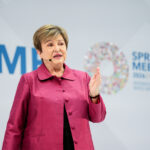
IMF managing director Kristalina Georgieva was speaking about the global economy’s prospects on Thursday while delivering the traditional curtain-raiser speech to kick off the IMF and World Bank Annual Spring Meetings 2026 in Washington D.C., United States.
The IMF’s current projection is that the Barbados economy will grow by 2.1 per cent this year, having expanded by 2.7 per cent last year.
Central Bank of Barbados Governor Dr The Most Honourable Kevin Greenidge, who is expected to participate in the Spring Meetings, said in January that “real GDP growth is forecast to remain around 2.5 to three per cent in 2026, reflecting continued momentum in tourism, construction, wholesale and retail trade, and business and other services”.
“Over the medium term, growth is expected to trend toward about 3.5 per cent per year, supported by sustained public and private investment, productivity reforms, and economic diversification under the Barbados Economic Recovery and Transformation (BERT) programme 2026,” he said.
Greenidge added: “Global growth conditions have softened but remain broadly supportive of Barbados’ outlook.
“According to the IMF’s January 2026 World Economic Outlook, global growth is expected to hold steady to around 3.3 per cent in 2026 and moderate to 3.2 per cent in 2027, with growth in Latin America and the Caribbean near 2.2 per cent in 2026 and 2.7 per cent in 2027.”
This Central Bank outlook preceded Israel and the US military action in Iran, which retaliated with attacks on other countries in the Middle East, a reality Georgieva addressed in her speech, which focused on Cushioning the Middle East War Shock.
Speaking at the IMF’s headquarters, the managing director said that “had it not been for this shock, we would have been upgrading global growth”.
“But now, even our most hopeful scenario involves a growth downgrade. Why? Because of significant infrastructure damage, supply disruptions, losses of confidence, and other scarring effects,” she explained.
“What we do know is that growth will be slower – even if the new peace is durable.
And we also know there are significant variations across the world. Countries able to export oil and gas undisturbed are the least affected.
“In contrast, countries directly disrupted by the war – including oil and gas exporters who suffered the blockade – and countries relying on imported oil and gas, still bear the brunt of the impact.
“How bad this impact will be will depend, in no small measure, on how much policy space countries have, including oil and gas reserves, given the five-week gap we have seen in tanker traffic from the Gulf,”
the IMF boss added.
Georgieva also said that the Middle East war impact on global economic growth “very much depends on whether the ceasefire holds and leads to lasting peace and how much damage the war leaves in its wake”.
The IMF’s latest World Economic Outlook, which will be published tomorrow “will include a range of scenarios, going from a relatively swift normalisation, to a middle scenario, to one where oil and gas prices
stay much higher for much longer and second-round effects take hold”.
“All these scenarios start from a situation where strong artificial intelligence and tech investment, supportive financial conditions, and other factors were driving considerable momentum in the world economy,” the managing director stated.
Georgieva had some advice for countries as they responded to the crisis, including increased energy prices – “don’t pour gasoline on the fire”.
“Policymakers can help in multiple ways, and, certainly, they must be careful not to make things worse. So here I appeal to all countries to reject go-it-alone actions -export controls, price controls, and so on – that can further upset global conditions,” she said.
“Beyond that, as in past shocks, alertness and agility are key. The challenge will be to detect if and when changing conditions take us from one state of the world to another.
“For now, there is value in waiting and watching, with central banks stressing their commitment to price stability but otherwise staying on hold – with a stronger bias to action if credibility is in question. Fiscal authorities should provide targeted and temporary support to the vulnerable, aligned with their medium-term fiscal frameworks.”
She continued: “Next, if inflation expectations threaten to break anchor and ignite a costly inflation spiral, then central banks should step in firmly with rate hikes. Fiscal support should remain targeted and temporary. Rate hikes, of course, would further dampen growth – that’s how they work.
“Finally, if a severe tightening of financial conditions adds a negative demand shock to the supply shock, then monetary policy returns to a delicate balancing act while fiscal policy – if and only if there is fiscal space – switches to well-calibrated demand support.”
The post IMF expects slower economic growth appeared first on nationnews.com.