By Kherim Nelson (St.Lucia Times)
“Do you think you will ever get that money?”
It is one of the questions advocates for reparatory justice say they are asked most often. Dr June Soomer, Saint Lucia’s former Ambassador to CARICOM and the OECS, was asked that very question during Monday’s Caribbean Conference on the Manifesto for the Enlightenment of Humanity, Socio-Economic Reparatory Justice, Reporting and Sustainable Development, held as part of the 51st Regular Meeting of the CARICOM Heads of Government underway in Saint Lucia.
Her response framed the discussion that followed, as delegates examined CARICOM’s renewed Ten Point Plan for Reparatory Justice.
“It’s not about the money. Yes, the money is important, but it is about the return of our dignity, of our personhood, of who we are as a people,” she said.
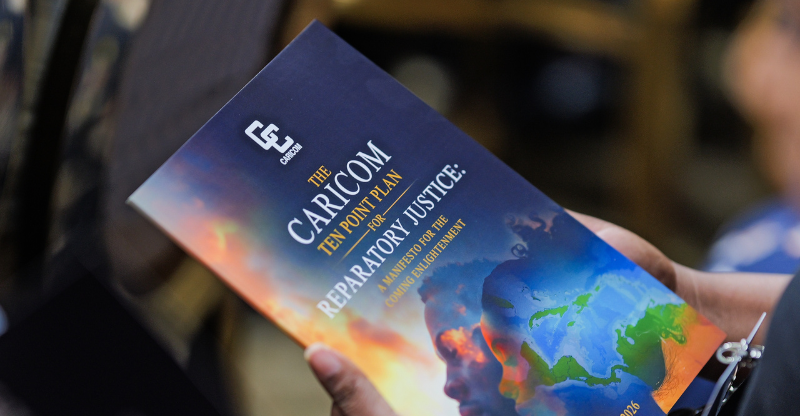
Titled A Manifesto for the Coming Enlightenment, the document outlines what the CARICOM Reparations Commission describes as a comprehensive approach to reparatory justice, charting a path towards “reconciliation, truth and justice for victims and their descendants”.
In presenting the manifesto, Chair of the CARICOM Reparations Commission, Professor Sir Hilary Beckles, urged the region to continue pushing forward, saying the movement had reached a point where the focus must now shift to actually achieving reparatory justice.
“This is our time, our duty, our responsibility to honour the legacy of all our ancestors who demanded justice,” Beckles said.
Inside the Ten Point Plan:
Below is a simplified overview of the Ten Point Plan. The full manifesto provides greater detail on each proposal and the reasoning behind it.
- A Formal Apology
CARICOM is calling on former European colonial powers to issue formal apologies for slavery and colonialism. The Commission argues that statements of regret are not enough because they do not acknowledge responsibility for the crimes committed.
- Repatriation
The plan supports programmes to help descendants of enslaved Africans who wish to return to Africa. This includes assistance with issues such as citizenship, resettlement and reintegration into their ancestral homeland.
- Indigenous Peoples Development Programme
CARICOM says Indigenous communities across the Caribbean continue to feel the effects of genocide, displacement and land loss. The plan calls for targeted investment and development programmes to help improve their social and economic well-being.
- Cultural Institutions
The Commission wants greater investment in museums, research centres and other cultural institutions that tell the story of slavery and colonialism from the Caribbean’s perspective. It believes that preserving and teaching that history is an important part of healing.
- Public Health
The plan argues that the legacy of slavery has contributed to many of the chronic health conditions affecting Caribbean people today, including hypertension and diabetes. It calls on European nations to help fund healthcare, research and public health initiatives across the region.
- Illiteracy Eradication
CARICOM says colonial governments left many Caribbean societies with high levels of illiteracy. The Commission believes former colonial powers should help support literacy and education programmes to address those longstanding inequalities.
- African Knowledge Programme
The plan proposes educational exchanges, cultural programmes and partnerships with Africa to help descendants of enslaved Africans reconnect with their history, identity and heritage after centuries of separation.
- Psychological Rehabilitation
Recognising the lasting emotional and psychological effects of slavery and colonialism, the Commission is calling for programmes that promote healing, education and a stronger sense of Caribbean identity.
- Technology Transfer
The Commission argues that colonial policies prevented the Caribbean from developing its own scientific and industrial capacity. It is calling for greater access to technology, innovation and technical expertise to support the region’s future development.
- Debt Cancellation and Financial Compensation
The final point calls for debt relief and financial reparations. CARICOM argues that many of the Caribbean’s economic challenges stem from slavery and colonialism, and that former colonial powers have a responsibility to help address those historical legacies.
While public debate around reparations often centres on financial compensation, CARICOM’s renewed Ten Point Plan makes clear that the regional movement is seeking a much broader form of justice. From education and healthcare to cultural preservation, technology transfer and debt relief, the Commission argues that repairing the legacy of slavery and colonialism requires more than a financial settlement. It is, as Dr Soomer put it, about restoring the dignity, identity and opportunities that were taken from generations of Caribbean people.
The post It’s not just about the money: Inside CARICOM’s ten-point plan for reparatory justice appeared first on Barbados Today.