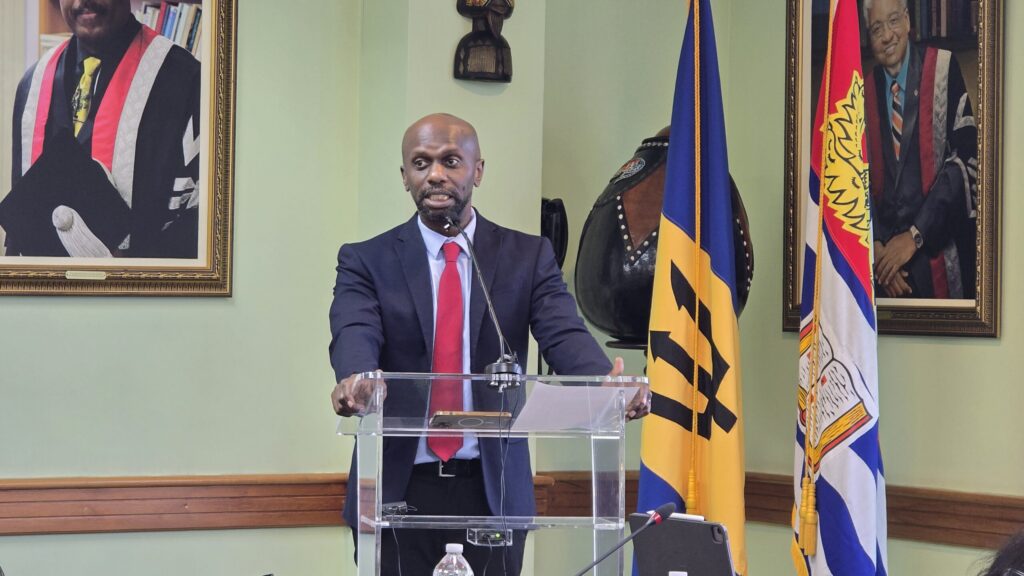
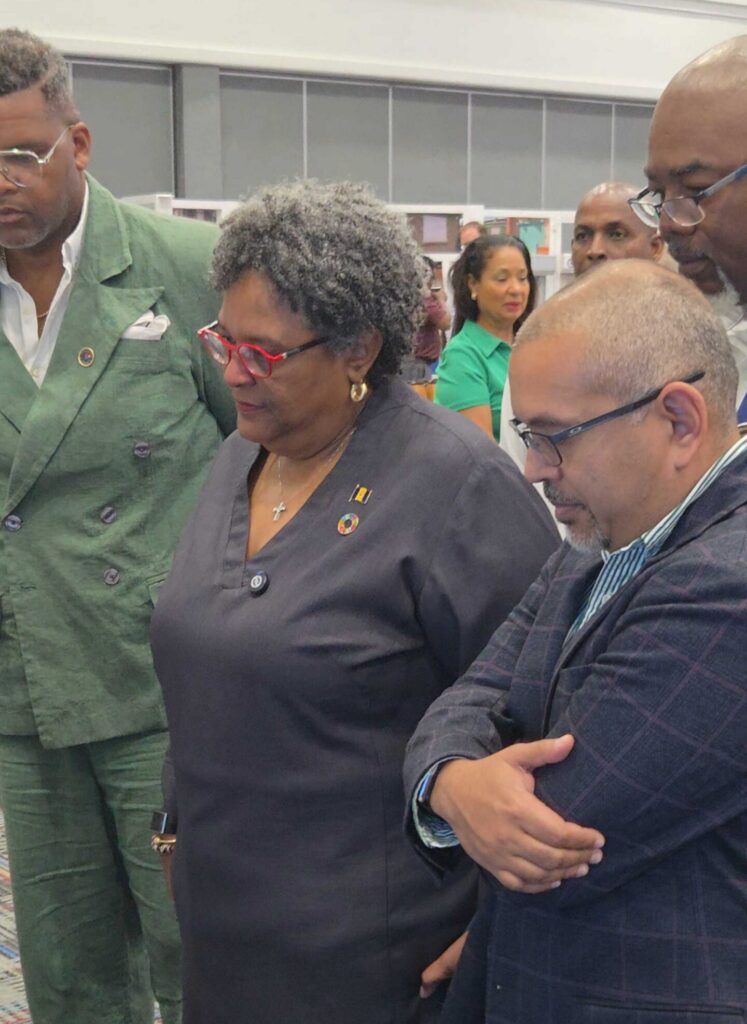
Barbados must urgently pivot to an export-driven economy, Prime Minister Mia Mottley has warned, telling manufacturers they must “innovate, aggregate, and pivot immediately” or risk falling permanently behind.
In a speech to the Barbados Manufacturers’ Association (BMA) State of Industry Conference, Mottley abandoned her prepared remarks to deliver what she described as a blunt mandate to the private sector, arguing that the country stands at a “critical historical crossroads”.
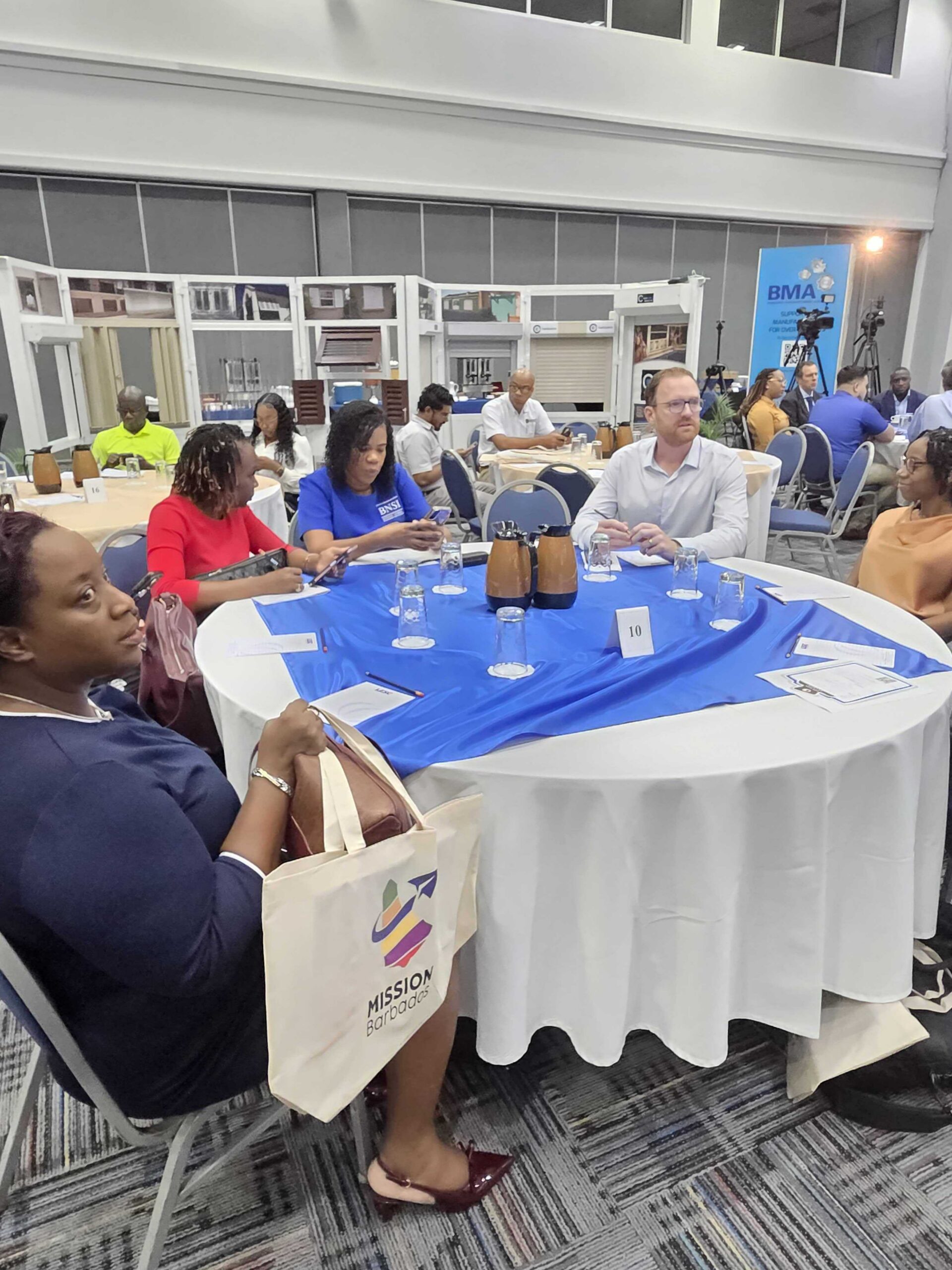
Industry Leaders attending BMA State of the Industry Conference.
“This country has done well. We’ve had 20 quarters of growth recently, and we can do better. We can go down or we can go up,” she told a packed room of industrial leaders. “But our being able to do better is not because I as prime minister or head of government want us to do better. It is going to do better only when we actually come to work to produce to do better.”
She explicitly rejected policy trends of the past 40 years, which she said had quietly sidelined manufacturing. While reaffirming her administration’s commitment to revitalising industry, she stressed that the government could only provide enabling infrastructure, with growth dependent on a shift in private sector mindset towards global expansion.
The prime minister pointed to historical trade data to illustrate what she described as a growing structural imbalance: “In 1960, Barbados exported approximately US$24m [$48m] in merchandise and imported US$49m [$98m] dollars in goods.”
By contrast, she said: “We were literally exporting US$461m [$922m] and importing $2.2bn [$4.4bn]. With our imports being almost five times what our exports are… over the course of our independent journey, it has become almost five times.”
While acknowledging rising consumer demand for imported goods, she argued that businesses had failed to expand sufficiently into export markets. “What hasn’t happened with sufficient pace and sufficient progress has been the extent to which we are prepared to claim the export market,” she stated plainly. “And unless that changes, we’re going to continue to be playing catch up all the time.”
Mottley also challenged manufacturers to rethink the constraints of Barbados’ population size, urging them to treat the CARICOM Single Market and Economy (CSME), with its six million people, as their effective domestic market.
“We have one clear platform that is not going to change: small size. The small size can mean nimbleness and agility, or small size can be a mental noose. And it is up to us to choose which one we want,” she said.
Highlighting structural disadvantages such as high production costs, she warned that competing in low-value, high-volume markets was not viable. “We will never compete with high volume and low value-added production—never,” Mottley said. “Without standards you’re not going to have access to a lot of markets, and with standards you start talking the language of the market… You have to understand the standards in order to be able to expand the market.”
Barbados must also play a role in shaping international standards, said the prime minister, drawing parallels with her administration’s global advocacy: “You have to be at the table in setting the standards, and that is all the Bridgetown Initiative is about, you know. That we have determined that nobody is going to set standards for us without us being present at the table because the standards which they set, the rules which they set, hobble us.”
Turning to financing, Mottley criticised what she described as an overreliance on debt and reluctance to share ownership among firms: “How many people in this room have gone to market to be able to benefit from an expansion of their production capacity by reason of equity or mezzanine capital, or are they only reliant on debt financing as their basis for movement?” she asked.
She linked this to deeper historical attitudes affecting business collaboration: “We are still suffering from a colonial-stroke-slave mentality as it relates to trust and therefore rather than open up and build the biggest company that we can with all of us putting in, we want all to keep a small one here, a small one there… We don’t realise that the high wind can take out each of the small ones, but if we come together and aggregate, we now have a different ball game.”
Mottley pointed to the government’s own fiscal reforms as an example of structural adjustment, noting that the national debt-to-GDP ratio had fallen from 177.5 per cent to 93 per cent, alongside economic expansion towards an estimated $17bn by the end of the fiscal year.
Energy costs were identified as another critical factor, with the prime minister describing affordable energy as “oxygen” for manufacturing. She cited Trinidad and Tobago’s US$40 bn [$80bn] trade surplus with CARICOM as largely driven by its energy advantage.
Amid geopolitical tensions in the Middle East and rising oil prices, Mottley revealed that the government had spent nearly two months in negotiations to shield Barbados from price shocks. “The government has taken a deliberate decision to be able to shield as much as we can,” she said, outlining efforts to cap fuel and excise taxes at an US$80 barrel equivalent.
She noted that while gasoline prices in the United States and United Kingdom had risen by about US40 cents per litre, increases in Barbados had been significantly lower.
“You can withstand heavy rain, so can I,” Mottley remarked. “What we cannot withstand is a deluge. And a deluge is what is on us if we were to allow a US40 cents per litre price to come. And this is where the hand of government policy makes the difference. You have to help carry some of the weight. The country is being asked to carry one-third of the weight, and the government, because it has a little more girth, is carrying two-thirds of the weight.”
But she warned that prolonged global instability could force adjustments, urging manufacturers to prioritise energy efficiency and smarter production practices.
Looking ahead, Mottley called for deeper regional integration, outlining a vision in which Caribbean nations pool renewable energy resources to become a major exporter of green hydrogen to markets such as the European Union.
She closed by commending manufacturers who had remained in business despite decades of decline, but urged a sharper focus going forward.
“Our ambitions must never, never be so low as to limit us from what is possible globally,” Mottley said. “We don’t need to produce more than five goods—five, out of the millions of goods that are produced globally. Pick five, but make them the best that you can make them.”
(RR)
The post Mottley urges export pivot as nation at ‘critical crossroads’ appeared first on Barbados Today.