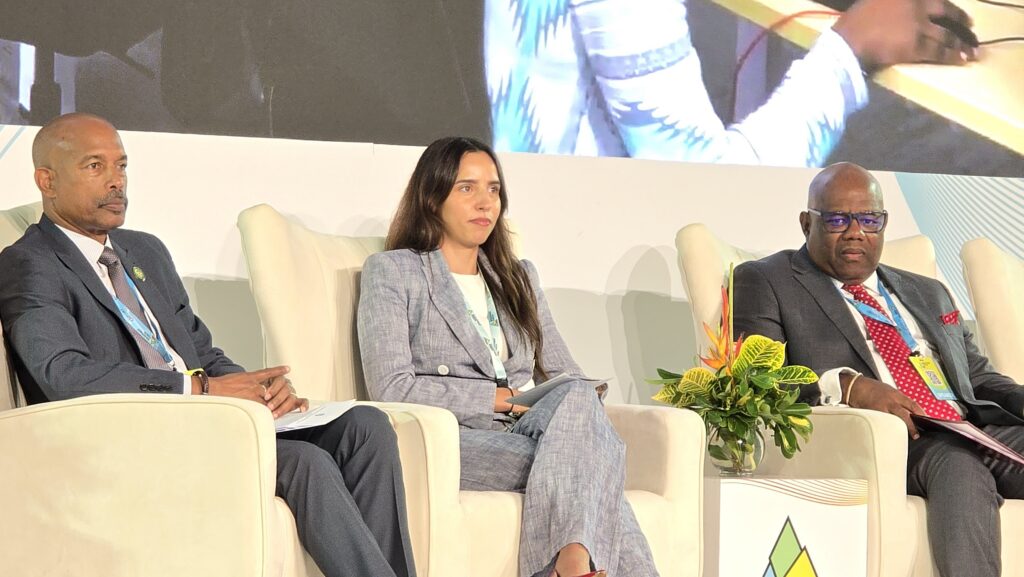
A first-ever regional sustainability bond was launched Tuesday to raise US$250m ($500m) to help Caribbean governments build climate-resilient infrastructure at below-market borrowing rates, with a market launch planned by the first quarter of 2027.
The bond was unveiled during the Caribbean Investment Forum at the Hilton Barbados Resort, with the CARICOM Development Fund (CDF) as its sponsor and Jamaica-based investment broker JMMB Group as arranger.
The bond would be issued through a special purpose vehicle, Caribbean Sustainability Investments Limited, according to CDF chief executive Rodinald Soomer.
He told the forum that the CDF had been mandated by CARICOM leaders, “led in particular by” Prime Minister Mia Mottley, to find an innovative way to issue growth and resilience bonds for the region.
Soomer said: “For the first time in our region’s history, we are launching a bond designed specifically to mobilise capital for growth and resilience, two pillars that are foundational to the Caribbean’s prosperity. Growth because our economies must expand in ways that create jobs, foster innovation and open new markets. Resilience because we must be prepared to decisively meet the climate, economic and social challenges posed by our present realities and that are exacerbated by our vulnerabilities.”.
The bond was being pitched to a wide pool of investors, from institutions to people, he added.
“The bond issue is designed to crowd in traditional and non-traditional sources of capital from sovereigns, multilateral development banks, international and regional financial institutions, institutional investors, down to individual investors at grassroots level, particularly Caribbean investors who can have a sense of ownership and pride in investing in the region’s economic growth and climate resilience.”
Soomer told Barbados TODAY the bond was the CDF’s second innovative financing facility. A resilience fund launched in 2024 raised capital for private business projects and offered investors commercial or near-commercial returns.
The new sustainability bond, he said, “would tend to attract impact investors that are not necessarily going for a commercial rate of return” but because of the “social, environmental, and economic impact, particularly in response to the impacts of climate change”, allowing the CDF to raise this financing at “more affordable rates”.
An important feature of the bond for Soomer was that the governments receiving the financing would not be adding to their debt burden: “A lot of the resilience building projects derive from the need to replace infrastructure that has been damaged through natural disasters, for example. So what you don’t want is to be providing that financing on terms that are going to exacerbate the debt situation.”
The bond would raise capital “at a concessional rate in some instances, and certainly way below market rates”, he stressed.
Soomer told the forum the money would go into three areas: climate resilience projects, from renewable energy to coastal protection; projects that diversify economies, including new technologies, sustainable agriculture and sustainable tourism; and projects that empower communities.
To get projects ready for investment, the CDF will also set up a joint project preparation facility with the African Export-Import Bank (Afreximbank).
The CDF’s 2024 facility, the Caribbean Community Resilience Fund (CCRF), had shown what blended finance could do, raising capital “far in excess of its initial target of US$100m [$200m]”. The CDF invested US$15m ($30m) in that fund as an anchor investor.
Karl Townsend, JMMB Group’s chief country officer for the Group Capital Markets Unit in Jamaica, said the Caribbean’s problem was not a lack of capital but a lack of scale.
He pointed to the cost of recent disasters, including losses of about US$12.2bn from Hurricane Melissa in 2025, or 41 per cent of Jamaica’s 2024 GDP.
Townsend said: “Our region is one of the most vulnerable to climate change and other economic pressures, yet we receive only a fraction of the global capital being deployed to address it. That is not because the need is absent. It is not because opportunities are lacking. It is because we have not always been positioned to access capital at the scale the moment demands.
“For investors, the effort involved in evaluating, structuring, and monitoring investment can be similar, whether the transaction is $5m or $100m.”
He added: “Rather than approaching the market with multiple smaller financing requests, we can bring together eligible projects under a single regional financing framework and present investors with a compelling Caribbean investment opportunity. So instead of fragmentation, we create scale.”
Townsend expanded the list of likely bond projects to include renewable energy, resilient infrastructure, water and wastewater systems, food security, housing, health care and climate adaptation.
The aim was to bring the bond to market no later than the first quarter of 2027, with talks with potential investors and funding partners already underway, he added.
Climate Bonds Initiative, an international organisation working to mobilise global capital for climate action and resilience, is to help decide which projects qualify, so investors could trust the resilience claims attached to their money.
Global technical assistance lead Meggie Eloy said a project would have to make a substantial contribution to adaptation and resilience, avoid significant harm to other environmental objectives and avoid making people, assets or ecosystems more vulnerable.
“This last point is really important,” Eloy said. “Building a seawall does not automatically mean that we have financial resilience. We need to understand what happens under future scenarios and whether it creates risks elsewhere.
“Our objective is simple. It’s to give investors the confidence that the capital that you provide is genuinely contributing to the climate outcomes being claimed.”
Townsend said the bond alone would not solve the Caribbean’s financing challenges, but could demonstrate a new approach: “Our ambition is for this to be the first of its kind, but certainly not the last.”
(LG)
The post New regional sustainability bond targets US$250m appeared first on Barbados Today.