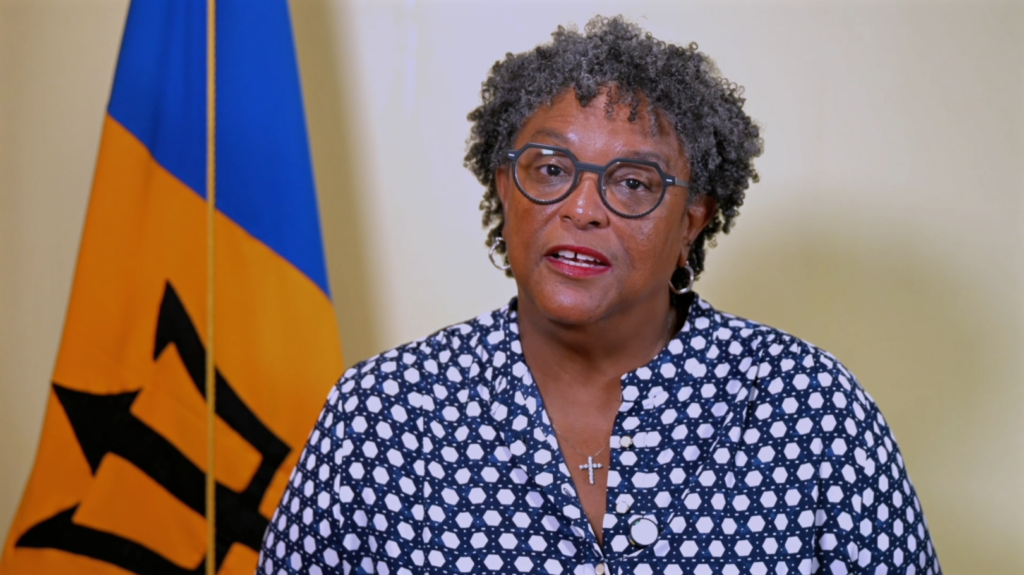
Prime Minister Mia Mottley has thrown Barbados’ support behind a push to curb the use of the United Nations Security Council veto in cases of mass atrocities, as she called for an overhaul of a system she said no longer reflects the world it serves.
Addressing the 81st United Nations General Assembly on Thursday, Mottley said Barbados was joining over a hundred other member states supporting the Franco-Mexican initiative on the use of the veto in cases of mass atrocities.
She coupled that position with renewed demands for permanent African representation on the 15-member Security Council and a greater voice for small island developing states (SIDS), noting: “The world we know has already changed. The council has not changed with it.”
At the heart of the prime minister’s argument was a challenge to the concentration of power within the Security Council, where five countries hold permanent seats and have the ability to block substantive decisions through the veto.
The five permanent members are China, France, Russia, the United Kingdom and the United States.
The other ten members of the council are elected by the General Assembly for two-year terms.
A negative vote from any of the five permanent members can block the adoption of a substantive Security Council resolution, even if it has secured the required support from other members.
Mottley said that both the composition of the council and the way that power is exercised must change.
“The Security Council still has 15 members, five of them permanent and armed with that veto,” she said.
“Africa, with 54 states, has no permanent seat.
And you’ve heard speaker after speaker after speaker come to this platform to say that this must change.”
She said small island developing states were also confronting threats that fall within the Security Council’s mandate, including climate insecurity, illicit arms flows, organised crime and displacement.
“And yet, despite constituting one quarter of the world’s states, we have no assured representation within the council,” she said.
“This too… must change.”
Mottley, however, argued that expanding representation alone would not resolve the problem.
“Reform is not only about who sits at the table.
It is about how power is exercised,” she said.
It was against that backdrop that she announced the island’s support for the initiative, noting: “Barbados is therefore joining 123 other member states in supporting the Franco-Mexican initiative on the use of the veto in the cases of mass atrocities.”
The initiative does not seek to abolish the veto.
Instead, it calls for the five permanent members of the Security Council to voluntarily refrain from using it in cases of mass atrocities.
“Its principle is fundamental. Where populations face genocide, crimes against humanity or largescale war crimes, the veto should not be allowed to paralyse the Security Council when action is most urgently needed,” she shared.
“This is why people are losing trust in the United Nations and its council.”
She said the situation was also unfair to the majority of member states that continued to believe in the UN and its ability to respond to global challenges.
Mottley’s intervention formed part of a broader argument that reform of the United Nations could not be limited to administrative changes while fundamental questions surrounding power and representation remained unresolved.
According to her, “We cannot move swiftly to reorganise offices and reporting lines while allowing the most consequential questions of power and representation to remain unresolved.
“Transformation and development, peacekeeping and humanitarian aid cannot succeed if member states are unwilling to fund it.”
The Prime Minister said the problems confronting the international community were not caused simply by a lack of knowledge or capacity.
Earlier in her address, Mottley noted continuing wars, an accelerating climate crisis, inequality and the emerging risks associated with artificial intelligence as challenges for which the world already possessed considerable knowledge and, in many cases, potential solutions.
The greater failure, she contended, was turning that knowledge into action.
“It is our repeated failure to convert what we know into what we do, to turn principle into practice and global capacity into solidarity,” she noted.
“So beneath our many crises lies yet another one. And yes, it is a crisis of responsibility.”
Mottley said that responsibility began within the United Nations itself.
She also challenged member states to adequately fund the international institutions they had established and to respect decisions even when they found them inconvenient.
“No organisational chart can overcome the refusal of states to respect decisions that they find inconvenient,” she said.
“We cannot continue to ask international organisations to do more while failing to provide them with the resources necessary to fulfil the mandates that we ourselves have agreed.”
The PM said Barbados had consistently met its responsibility to the multilateral system and would continue to do so.
She noted that commitment to a rules-based international order had to be measured not only by what countries demanded from international institutions, but by their willingness to sustain them.
Mottley stressed that an equitable international system was particularly important for smaller countries such as Barbados.
“Without an equitable rules-based order, smaller states like mine will simply cease to exist in this world,” she warned.
“So yes, let us improve the machinery, but let us also reform the exercise of power,” Mottley said. (SM)
The post PM Mottley challenges UN veto power appeared first on Barbados Today.