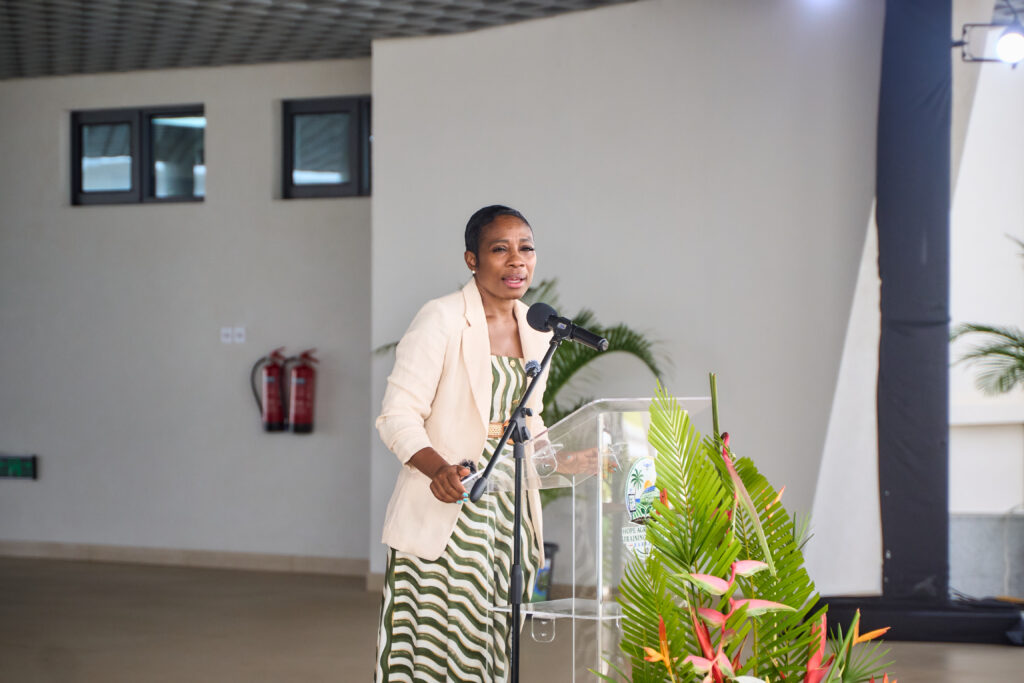

A “mentality disconnect” between political leaders and multilateral development bank boards is undermining crisis response in vulnerable nations, Prime Minister Mia Mottley warned on Wednesday, as she cautioned that a looming insurance crisis could destabilise Caribbean economies within a decade.
In a high-level fireside chat at the Inter-American Development Bank’s Sustainable Week conference at the Wyndham Grand Barbados Sam Lords Castle resort, Mottley delivered a characteristically blunt assessment of the global financial architecture.
Sitting alongside IDB Invest chief executive James Scriven, Mottley said that despite rhetorical support from world leaders, institutional bureaucracy continues to stall critical funding as the region battles escalating climate and economic shocks.
“When I meet the political class, ‘oh yes, yes, yes,’” Mottley said, illustrating the contrast between political promises and bureaucratic reality. “And when we get to the board, all of a sudden, you can’t even do proper policy-based lending at the IDB because of a foolishness that seeks to rely on artificial rules that were set ten years ago, when in truth and in fact, you have the balance sheet that can cover it.”
The prime minister stressed that Caribbean nations do not have the luxury of time to navigate regulatory inertia.
“I can’t sustain the mentality disconnect between capitals and the boards,” Mottley told the audience of investors and policymakers. “And that’s what’s killing us… It’s not right, it’s not fair, and what is happening because we’re in a bloody crisis moment. We do not have the buffer.
“We do not have the time that people think that we have.”
The discussion highlighted the profound impact of the Bridgetown Initiative, a Barbados-led proposal designed to reform the global financial system to better support climate-vulnerable developing states.
Scriven acknowledged that the initiative has fundamentally altered the international development landscape.
“We’ve seen, even though we have a tremendous amount of money coming from Barbados, a lot of the transformations that are happening in the financial development world are coming out of Bridgetown over here,” Scriven said, prompting Mottley to outline how those concepts have transitioned from bold ideas into mainstream financial mechanisms.
Mottley credited the initiative with driving the implementation of the International Monetary Fund’s Resilience and Sustainability Fund, alongside pioneering debt-for-nature and debt-for-climate swaps.
She revealed that Barbados is now aiming to break further ground by collaborating with the World Bank, the Caribbean Development Bank and the Latin American Development Bank on a scaled-up “debt-for-social swap”.
Mottley also pushed back against initial scepticism from Wall Street regarding the inclusion of natural disaster and pandemic clauses in sovereign bonds — clauses that temporarily suspend debt servicing when a catastrophe strikes.
“We were told, if you’re involved, that the market would not accept the natural disaster clauses,” Mottley reported.
“And I’m here to report that when Barbados went from the American market index last June, we went to US$500m. We got bills of $2.7bn. And in every instance, we had absolutely no difficulty in pursuing those bonds with natural disaster clauses and, by the way, pandemic clauses.”
She explained that these clauses provide vital fiscal predictability, noting that if disaster strikes, Barbados can unlock the equivalent of 17 to 18 per cent of its GDP over two years. “It is the certainty that it creates in the minds of the lender,” she added.
Mottley also identified a major unaddressed threat to regional economies: the rapidly collapsing accessibility of commercial insurance due to systemic climate risks.
She warned that skyrocketing premiums could soon prevent local enterprises, particularly tourism operators, from securing commercial loans that require insurance covenants.
“The big elephant in the room as well for the Bridgetown Initiative, which we’ve not seen sufficient progress on, and I don’t think the world is taking it seriously enough, is the issue of insurance,” Mottley asserted.
“If the cost of insurance becomes prohibitive or, worse than that, inaccessible… we then have problems because these hotels that are depending on access to that funding will not now be able to compete.”
To prevent what she described as a “collision coming in five to ten years’ time”, Mottley called for a regional structural shift, urging the financial sector to aggregate small-island risk across the Caribbean, Indian and Pacific oceans to create market scale, rather than local insurers operating merely as brokers to international reinsurance markets.
Turning her attention to broader environmental policies, Mottley launched into a passionate defence of aggressive, targeted global action against methane emissions, describing it as “80 times more destructive than carbon” in the short term.
“The enemy is not the oil and gas sector. The enemy is the emissions,” Mottley argued, adding that controlling methane could rapidly buy the planet time while long-term decarbonisation technologies mature.
“If you can control the emissions, whether from methane or from carbon, then we begin to win the battle.”
While addressing environmental challenges, Mottley concluded on a note of local scientific innovation regarding sargassum seaweed — a persistent nuisance for Caribbean tourism.
She highlighted Indian-born Barbadian scientist Dr Bidyut Mohapatra’s discovery of three new microbes within the seaweed, opening the door for synthetic applications in breakthroughs such as antibiotics, plastic degradation, nitrogen fixation and oil spill management.
Despite intense international interest, Dr Mohapatra insisted that the economic benefits of his innovation will remain in the Caribbean. Mottley told the gathering that they will be seeking international partners to support Dr Mohapatra’s efforts.
“Everything about Sargassum, it is a nuisance,” Mottley concluded, “but it may well have some serious benefits to the global community.”
(RR)
The post PM: Soaring insurance rates could choke economies ‘within decade’ appeared first on Barbados Today.