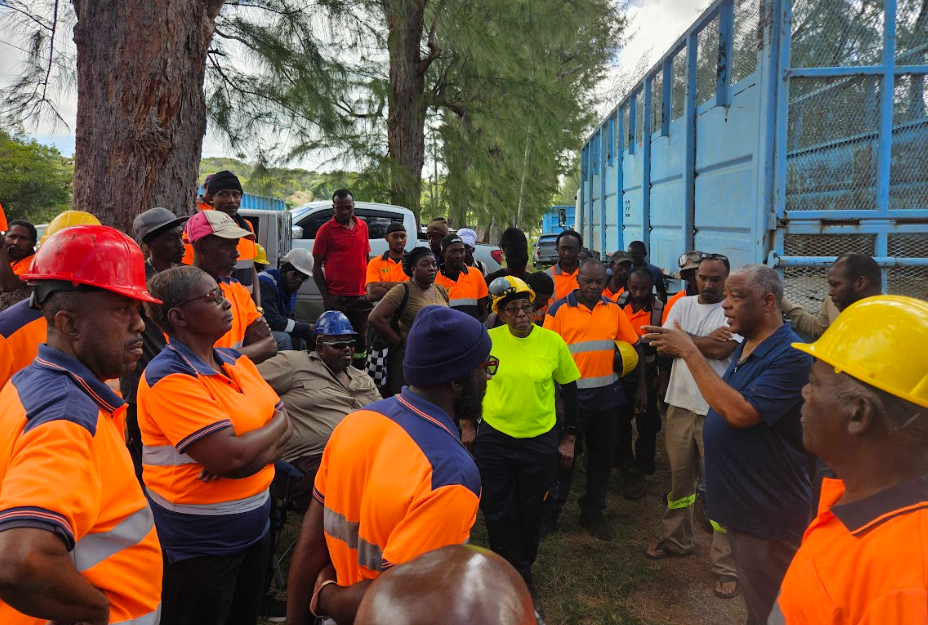
A simmering row over union recognition and working conditions erupted into industrial action on Wednesday when dozens of workers at the Portvale sugar factory walked off the job, disrupting the second day of the already-delayed sugar harvest.
The dispute centres on competing claims over worker representation and allegations of poor working conditions, with the Unity Workers Union (UWU) insisting it represents the majority of employees at the island’s only sugar mill, run by Barbados Energy and Sugar Company Inc (BESCO) which recognises the Barbados Workers’ Union (BWU).
According to UWU General Secretary Caswell Franklyn, about 50 workers had joined the union and withdrawn their labour in protest at management’s refusal to recognise it.
He said the union applied for recognition on July 26 last year after securing the support of a majority of hourly paid employees but claimed management had ignored repeated correspondence.
“We applied for recognition and we had 55 persons [initially] out of the 83 that they had employed hourly paid workers. To this day, management has refused to even acknowledge the letters,” Franklyn said.
The union leader added that the UWU had warned of possible industrial action earlier this year.
“We wrote them again on 16 January telling them that we will take industrial action by the end of January, but then the elections intervened and we didn’t want it to appear that we could decide to anybody during the election period, so we suspended our action,” he said.
Franklyn argued that workers were not consulted ahead of the start of the sugar harvest.
“Then we heard by way of the press that the crop will start yesterday. Nobody talked with the workers. Nobody talked to the workers’ representatives, and they have been treating these workers very badly for too long.”
He also accused management of breaching labour regulations by requiring employees to work excessive hours without overtime pay.
Franklyn said: “The Shops Act says that you can work eight hours. Anything over eight hours a day is overtime. Anything over 40 hours a week is overtime. They are asking these workers to work 56 hours a week without any overtime payment. That’s two days additional that they’re working without overtime.”
According to the UWU leader, workers have also been scheduled to return to duty with insufficient rest between shifts.
“You go home at night at 11 p.m. and come back at 7 a.m. That’s also against the law. You cannot ask a person to report for work under 12 hours. There must be at least a 12-hour break between. Somebody’s got to go home and sleep. And these people operate heavy machinery. They cannot continue in this game unless they want somebody to die.”
Franklyn further alleged degrading conditions at the factory, including workers being unable to leave their stations to use the bathroom.
“I only found out last night that we have people here who have to sit down at their station for eight hours straight and when he wants to use the bathroom he uses the bottle. This is happening in Barbados today.”
The union leader also raised concerns about sanitation and maintenance issues at the mill, describing the factory’s physical condition as hazardous.
“The factory is a hazard. The roof leaks like a sieve. One of the areas that leak is the powerhouse, and you can’t have high voltage with the roof leaking because anything can happen. You’re talking about frying somebody.”
He also accused management of attempting to blame workers for delays in the crop.
“They’re trying to give the impression that it is this union and our membership that is stopping the crop from starting. No, it is them.
“They order the wrong parts and the machinery can’t use wrong parts. How can you blame the workers for them ordering the wrong thing?”
Franklyn said the union remains prepared to meet with management but insisted workers would not return until their concerns are addressed: “I am ready, willing and able to meet with them at very short notice, but unless that happens they’re going to run the factory without them.”
In a statement on the strike, BESCO said approximately 38 sugar workers had been called off the job by the UWU but insisted the majority of employees remain represented by the BWU.
“Currently the general public should be aware that some thirty-eight sugar workers have been called off the job by the Unity Workers Union,” the company said.
BESCO maintained that the BWU remains the recognised bargaining agent and defended the industry’s compensation model.
“The current compensation model has been the standard in the industry for decades and negotiated with the workers’ representative, the BWU. The company maintains that workers are compensated appropriately for overtime for any work that extends beyond the normal working hours.”
The company said engaging multiple bargaining agents simultaneously is not standard private sector practice and described the action as an unauthorised strike.
“In these circumstances, the withdrawal of labour by the workers is considered by the company to constitute a wildcat strike,” the statement said.
BESCO warned that workers participating in such action traditionally forfeit pay during the period they remain off the job and urged them to return to work while discussions continue through established industrial relations channels.
“The sugar industry has always had a unique model of operation which differs in-crop and out-of-crop, and employee compensation is adjusted to ensure fairness between the two seasons … Any changes to the compensation model should be the subject of negotiation with the recognised union.”
The latest dispute unfolds against the backdrop of continuing uncertainty in the island’s sugar industry following the restructuring of the sector after the decline of the state-owned Barbados Agricultural Management Company (BAMC).
In January 2024, the then agriculture minister, Indar Weir, announced a new ownership structure under which Co-op Energy would hold a 55 per cent majority stake in the industry, with 20 per cent allocated to rehired and former BAMC workers and 25 per cent retained by the government for sale to Barbadians who had never worked in the industry.
Two companies were established to manage the restructured industry: Agricultural Business Company Ltd, based at Bulkeley in St George, and BESCO, which operates the Portvale sugar factory. Together they assumed responsibility for sugar cultivation, milling operations, by-products and sales after taking over from BAMC when the new entities began operations on January 15 2024.
However, the transition later encountered major setbacks. In August 2025, the memorandum of understanding between the government and Co-op Energy collapsed. Government claimed the investor failed to raise $16.5m in equity financing, while Co-op Energy claimed that funds would not be released without audited records and clear asset listings.
The termination derailed what had been presented as a historic step towards worker participation in the ownership of the island’s sugar industry and has contributed to continuing tensions within the industry.
The post Portvale walkout halts sugar harvest amid union recognition battle appeared first on Barbados Today.