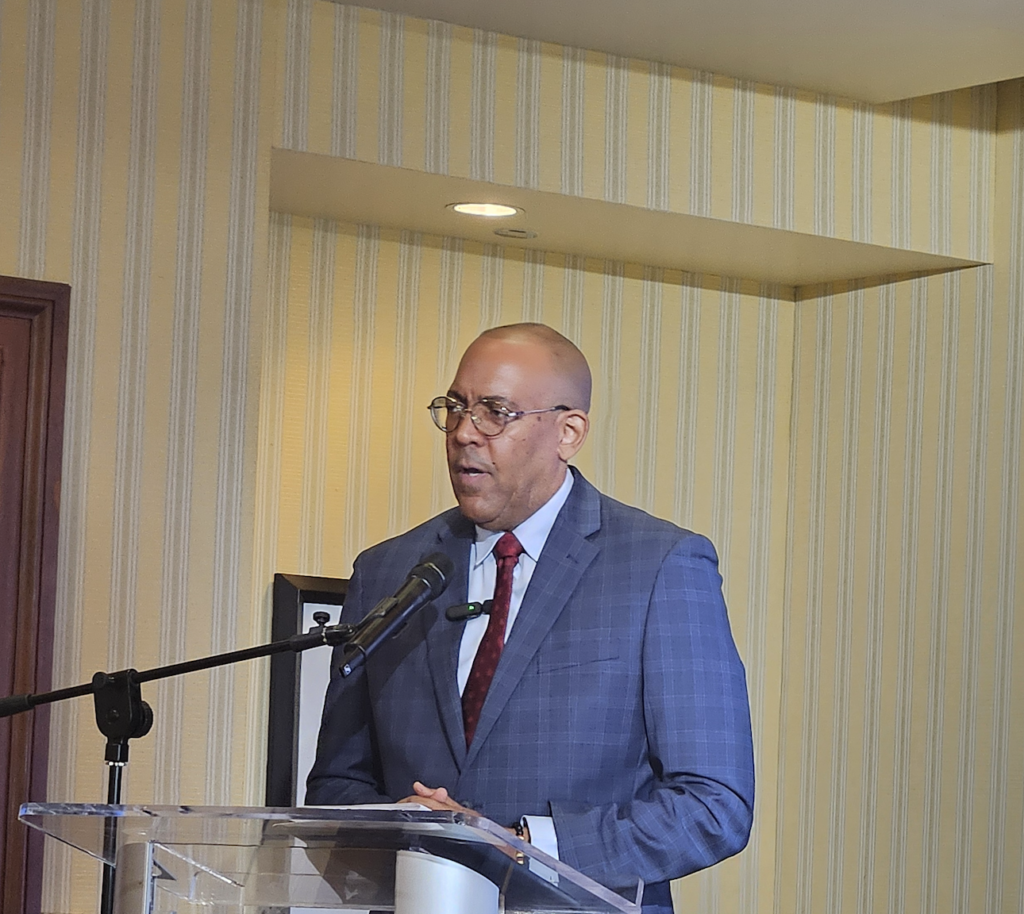
It cost more than $2 billion for Barbados to wean itself off fossil fuel dependence as it advances its 2030 energy goals, acting Prime Minister Kerry Symmonds revealed on Tuesday.
“The entire renewable energy transition is probably going to cost this country in excess of $2bn with a B,” he told journalists as the Mottley administration launched a direct negotiations process for oil and natural gas exploration.
Symmonds insisted that the transition away from fossil fuels remains a key objective under the 2019 National Energy Policy, even as Barbados explores the development of offshore oil and natural gas resources.
He said: “The National Energy Policy clearly speaks to the alignment with renewable energy and the transition towards doing more and more things through renewables, but also the maintenance of natural gas as the fuel, which is a bridge between us and there.”
Natural gas is viewed as a cleaner fuel during the transition period and also plays a key role in financing renewable energy development, he said.
“It isn’t just that it will be a fuel that you can use while you are also using or beginning to expand renewable energy. It also assists us in financing the renewable energy effort.”
He pointed to several major projects under consideration, including a wind energy project at Lamberts and the introduction of battery storage systems.
“So if, say for example, we were able to find huge deposits of natural gas and we utilise it domestically in part and sell to other people who wish to be off takers of that natural gas, then the proceeds of those sales enable to then make investments, for example, we are now looking at Lamberts at an investment that may well run in excess of US$200m [$400m] for wind turbines.”
“There are several other proposals which will be very expensive. We also have to get battery storage, which will shortly be on the island, and that battery storage is going to come at a cost of several hundred million.”
The potential revenue from future oil or gas production could help to offset some of the costs and support the transition in a more sustainable way, said the energy minister.
“If we are able, therefore, to help finance it by the sale of oil or the sale of gas to the international community, then effectively we are in a position where we are helping to finance the essential transition, but we are doing it in the most responsible way that we’ve been able to identify.”
The government has maintained that its long-term goal remains achieving 100 per cent renewable energy and carbon neutrality by 2030, with natural gas serving as a bridging fuel.
Any future offshore development would be structured to ensure Barbadians benefit directly, with local content provisions expected to be brought to Parliament, Symmonds added.
This, he said, would create opportunities for employment and wider economic participation.
“What we are doing is also trying to structure partnerships with people who will provide and respect the need for Barbados, provide a solution and respect the need for Barbados to have local content in these discussions and negotiations.”
He explained: “By local content, I am talking specifically about the ability of Barbadians to get jobs, the ability of Barbadians to provide services. The ability of Barbadians to be able to get some of the direct economic benefits from oil exploration.”
He also pointed to skills transfer and long-term capacity building as key benefits.
“The technical transfer, the knowledge, skills, the base of understanding and capacity which the country’s energy company can develop as a result of these negotiations.”
Symmonds acknowledged that the Barbados National Energy Company – the state-owned enterprise that merged the former domestic oil producer Barbados National Oil Company and natural gas provider National Petroleum Corporation – currently has no experience in offshore oil and gas production. But the intention is to build capacity over time, he said.
“Let us say 10-15 years down the road, to be doing in one of the blocks which we have offshore, those things that we must now ask, Shell or Exxon or whoever else to come into the country in order to do so, we want to be able to build out that capacity so that our own people and our own company will be able to one day hopefully play a major role on its own. So that the local content effort will be pursuant to legislation which is now in draft with this ministry.”
Symmonds also highlighted broader economic spin-offs from exploration activity:
“Those folks who are coming from outside of the region to engage in the energy production or the exploration are going to have to have some place to rest their heads until the oil platforms out there are going to have some somewhere to eat and are going to have to have all the other things that people who are long stay visitors in Barbados do and so from that perspective, it is also a benefit to the Barbados economy.”
(LG)
The post Symmonds: Energy transition to top $2 billion appeared first on Barbados Today.