
The creative industry must urgently move from pride to profit by legally protecting and commercialising its cultural exports — or risk “failing by convention”, Minister of Energy, Business Development and Commerce Kerrie Symmonds has warned.
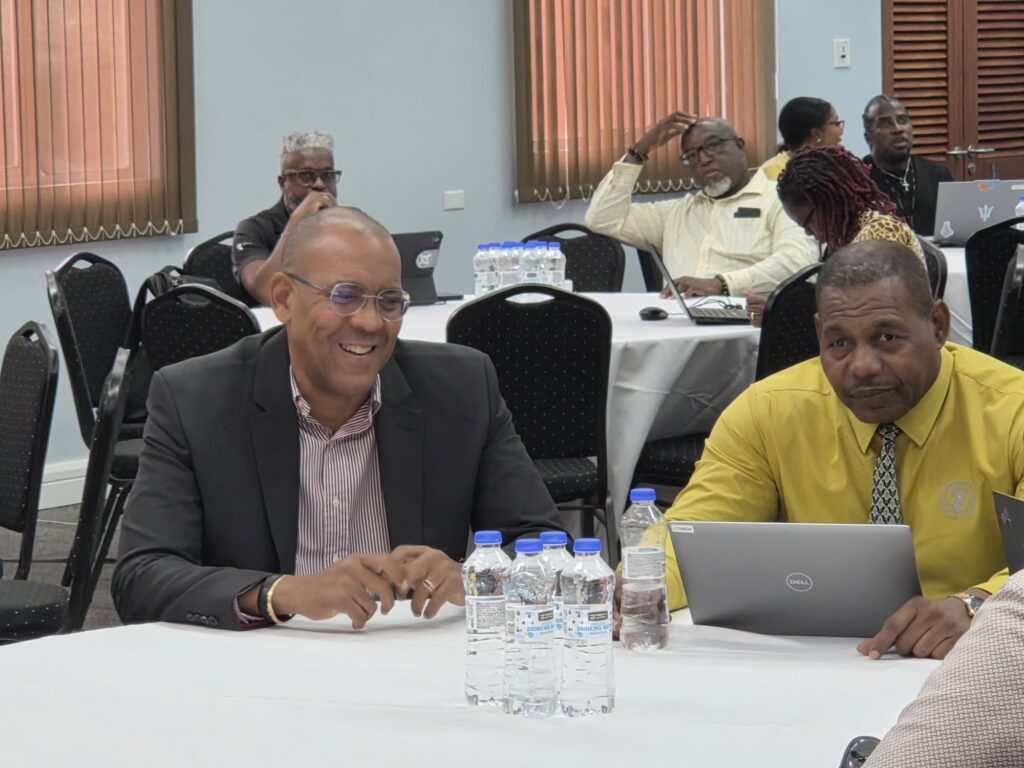
Addressing the Third Annual Barbados Orange Economy Consultation, hosted by the Barbados Coalition of Service Industries (BCSI) at the Sagicor School of Business, the senior minister argued that the island stands at a critical crossroads between traditional stagnation and a transformative, sustainable financial future.
Symmonds began by acknowledging the intense pressure of his dual energy and business development ministerial portfolio, noting that while the international oil and gas industry demanded his immediate attention, the development of the orange economy remained an absolute priority for national diversification.
He praised the consultation’s theme of monetising creativity but quickly shifted to a blunt assessment of the region’s historical tendency to “diagnose problems to death” without taking decisive action.
“We are at the crossroads of a model of development in Barbados which is, on one hand, going to be very conventional and traditional,” Symmonds said. “If we continue along the conventional and traditional path, we are going to continue to encounter pitfalls through our progress collectively, and I think we are destined to fail.”
To illustrate the danger of inaction, the Minister pointed to the global manufacturing of the steelpan, an instrument birthed in Trinidad and Tobago but now largely monetised by foreign powers.
He revealed that entities in the United States, Japan and China have captured over 40 per cent of the world’s steelpan manufacturing because the home of the instrument failed to secure a “first-mover advantage.”
He warned that Barbados’ national sport, road tennis, faces an identical threat of being co-opted if the island does not move beyond using the game merely for “soft diplomacy.”
“We have taught the Rwandans the game and we’ve taught people in Latin America the game, but having taught them this and whetted their appetite, we still don’t own it in the way that we need to own it,” Symmonds cautioned.
“What happened with the steelpan in Trinidad could easily happen to us with regard to the road tennis experience. Imagine if we had so structured that which we do to make sure that there was a special way for a tennis racket for a child, a special way for a female, and that it was unique to Barbados. That is the form of ownership that enables us to monetise, that enables us to set it aside with what they call a geographical indicator and say, ‘This is our sport,’ and then you are able to sell it at a premium.”
The minister also expressed deep dissatisfaction with the lack of progress following the 2008 Economic Partnership Agreement (EPA) with the European Union.
Despite 27 European countries opening their doors to Caribbean entertainers, Symmonds noted that the region has failed to capitalise on this “unprecedented opportunity” due to a lack of dedicated funding and technical support.
He criticised the “policy incoherence” that allowed trade priorities to be eclipsed by external agendas, such as North Atlantic discussions on human rights and gender identification, which he argued diverted focus from building a space for creative practitioners in the world’s largest markets.
“Telling folks who are acting or telling folks in music, ‘Oh, you’re free to go to Europe,’ but not enabling them to go to Europe and ensure that they can make money is virtually doing nothing,” the minister declared. “We sat down with the same Europeans and allowed them to tell us what the priorities of our future relationship must be, and it was not culture. These things disturb me.”
To bridge the gap between creative passion and commercial reality, the senior minister announced that the government is finalising the infrastructure for a junior stock exchange to facilitate equity financing for creative businesses.
He urged practitioners to stop viewing themselves as a casual interest group and instead model themselves after the aggressive advocacy seen in the tourism and cruise sectors.
“In life, the hinge that is more squeaky is going to get the attention and the oil,” Symmonds remarked. “One must constantly be reminding the sector and the sector’s leadership that not only that you exist, but that there are certain business interests that are critical and that this is not just a passion pursuit. For many people, the concept of monetisation of creativity is really a lived reality. This is people’s bread and butter.”
Symmonds described the orange economy as “low-hanging fruit” for economic diversification. He pledged that his ministry would serve as a listener and a partner to ensure that Barbadian creativity is no longer just a national pride, but a protected global commodity.
The post Symmonds urges creatives to protect, profit from culture appeared first on Barbados Today.