
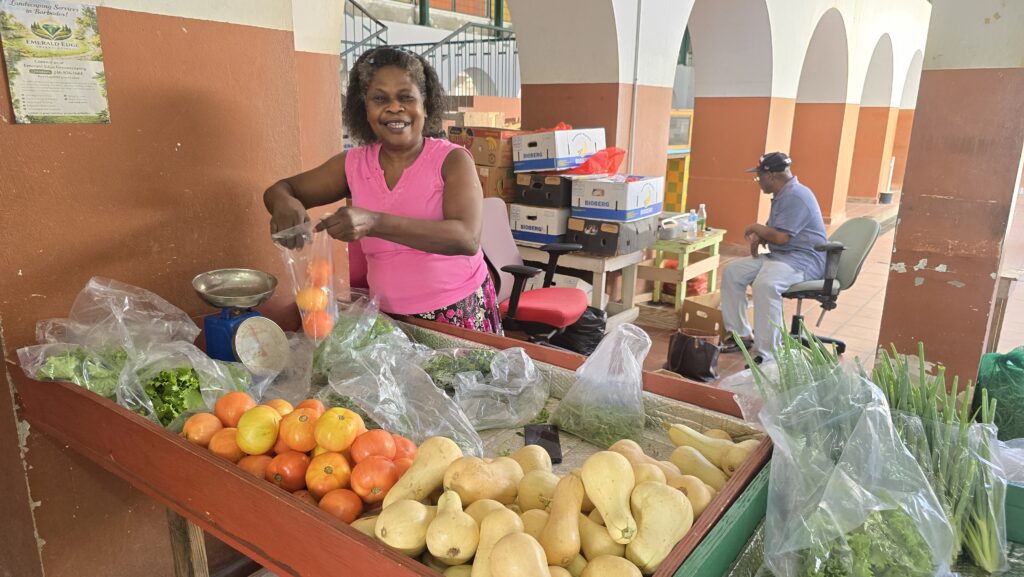
A pilot plan to transform Cheapside, the island’s oldest farmers’ market, into a more organised, year-round attraction has gained support from some vendors, but others are doubtful it will work, saying similar efforts have failed because many sellers use the market as a storehouse and prefer to ply their trade outside.
The proposal was revealed by the Ministry of Agriculture’s manager of markets, Sherlock King, during a colloquium on Monday. The initiative forms part of the ministry’s wider transformation agenda.
Barbados TODAY sought the views of several Cheapside vendors on the proposal.
A vendor from St Vincent said if the plan is successful, it could attract more customers, but only if vendors cooperate:
“In St Vincent used to have the same things but the last few times I visited I was so shocked, they built four markets and took all the vendors off the road, and they inside and everybody making money. I went Saint Lucia and it’s the same thing.”
In those markets, vendors operate inside throughout the week, and stalls are kept clean, she said.
“They’ll get sales,” she said, noting that some vendors do not attend the market daily, but only come out on select days at the end of the week.
One of her colleagues disagreed, saying some shoppers prefer outdoor markets:
“We can’t tell people where to shop, if you go all over the world, you’ll see vendors on the outside because people like outdoor shopping.”
Saturdays remain the busiest day for the indoor market, the vendor said:
“When you look on Saturday, the market inside does have more people than people coming round here shopping, and that’s the honest truth. When you go there on Saturday morning, you see a whole heap of people shopping and couple people walking out there. Like today Thursday, the whole place dead.”
Both vendors agreed that more activity and entertainment within the market could help attract customers, especially since low foot traffic has led some vendors to leave the downtown facility.
“Clothes stalls and food stalls but they say nobody ain’t coming in the market,” one said.
The other vendor said better promotion could also improve activity.
“They should have a sign for clothes stores, food court, because nobody don’t know.”
Tourists often pass through but are unsure where to go, the vendor said.
“Sometimes tourist pass and ask where they can get something to eat but there’s no sign.”
Long-time vendor Roy said that while he supports the initiative, he would wait to see it implemented:
“I want to see, I don’t want to hear talk. So when Mr King come down here, yes anything can happen, if they trying new things, let them come and try.”
Another long-time vendor, Angela, was less optimistic, saying similar attempts have failed before:
“They trying that for years, they try all sorts of things and it didn’t work, so I don’t know how it going to work now.”
Many vendors currently use the market more as a storage space, placing produce outside rather than operating inside:
“The vendor trays and benches are stored in here. [In] the morning time, they take them back out and sell outside, they don’t sell in here. Nobody [wants] to be in here.”
Cleaning schedules and slow midweek trade also affect market activity, Angela added.
On Mondays, the interior is washed down, leaving it wet, while Tuesdays to Thursdays tend to be slow with only a few vendors inside.
Angela suggested that the market could be more viable if all vendors agreed to operate inside, but said incentives would be needed.
She declared that the market is currently operating below potential because limited indoor activity affects staff and overall operations.
Another vendor said the idea could work if properly managed, comparing it to Oistins, but argued that sanitation issues must be addressed first.
“I hear they talking about it, say they want it to look like Oistins… number one – rat; they got to get rid of that first and that not possible. They say we got to move from here, but you can’t listen to people; you have to wait to see what the government say.”
She said she is prepared to go along with whatever decision is made.
Taking its name from its London counterpart, Cheapside has seen buying and selling since 1810, at the height of slavery. It was established as a purpose-built space where both enslaved and free vendors could legally trade produce under cover from the elements, following earlier informal street vending and an 1806 fire that cleared the area.
Over time, the bustling hub has been expanded and modernised – including a major renovation supported by Chinese grant funding in the early 2000s.
(LG)
The post Vendors divided on Cheapside plan appeared first on Barbados Today.