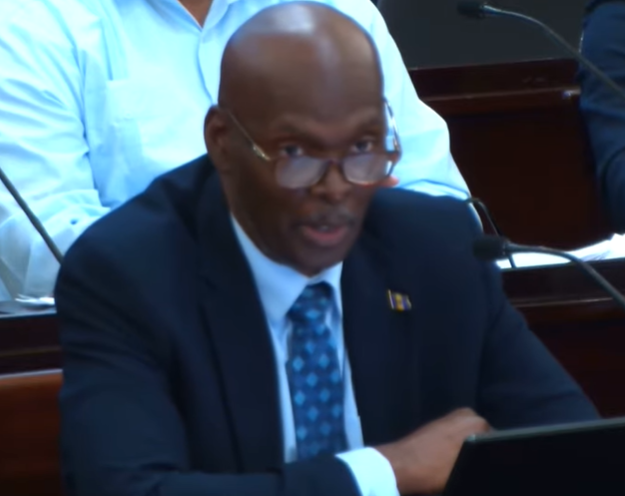

Former Central Bank Governor Dr Delisle Worrell has warned that Barbados should abandon any expectation of getting cheaper oil deals from its Caribbean partners, since oil and fuel trade within CARICOM is priced and paid for in US dollars — just like imports from the United States or India.
Dr Worrell, who led the Central Bank of Barbados and served as a consultant with the International Monetary Fund (IMF), advised that whether Barbados buys petroleum from Trinidad and Tobago or from the US, it pays the same rate.
Dr Worrell explained that this was because trade among CARICOM member states is settled in US dollars, in the same way as transactions with the US and other countries.
“It makes no difference to Guyana or to Trinidad whether they sell oil to Barbados or the US because the price is the same in either case and payment is always in US dollars,” the senior economist advised in his March Economic Letter.
He contended: “It makes no difference to Barbados whether it buys in the US or in Trinidad, because the impact on the foreign currency market is the same. Across the region, the specific terms of individual contracts may matter, but it is of no consequence whether the source of the product is Guyana, Trinidad or an extra-regional supplier.”
The former IMF consultant on monetary policy, financial stability and stress testing said that even though Guyana became CARICOM’s largest oil producer in 2023, no CARICOM country currently imports oil from that state.
“In fact, Guyana imported US$21m [$42m] of fuels, oils and distillation products from Jamaica in 2024, a reflection of the fact that Jamaica has an oil refinery and Guyana does not. Barbados and the Eastern Caribbean Currency Union (ECCU) do import some fuels from Trinidad and Tobago – until recently CARICOM’s only major oil and gas producer – although their main suppliers are the US and India.”
The economist said there was minimal intra-Caribbean trade in fuels, noting that the regional market was too small to make it profitable to refine crude oil locally or to ship it across the Caribbean Sea for sale within the region.
The region’s refineries were built to serve the North American market, and that the residual amounts sold within CARICOM had stagnated following the closure of refineries in Trinidad, Aruba and elsewhere, he said.
“What is of significance for the balance of payments of CARICOM countries is the fact that Guyana’s payments to Jamaica, Barbados’ payments to Trinidad and Tobago, and all other fuel purchases among CARICOM members, are made in US dollars, just like these countries’ oil imports from the US and India.”
In the absence of a single currency in common use throughout the region, intra-CARICOM trade brought no foreign currency benefit to member countries, Dr Worrell said.
“Imports of food, pesticides and other manufactured products from member countries are paid for in US dollars, just like imports from non-member countries. With the advent of oil production in Guyana, there is now no prospect of that country becoming the breadbasket of CARICOM; but that makes no difference to the balance of payments of any member country because imports of food from Guyana are paid for in US dollars, just like all other imports.”
He recalled that before 1971, when the US went off the gold standard, the countries that now make up the Caribbean Community all had national currencies fixed to the US dollar, at $4.80 Eastern Caribbean currency per US dollar, 83 cents Jamaican per US dollar and one Bahamian dollar per US dollar – a rate which remains unchanged.
The economist noted that the Eastern Caribbean dollar was the common currency for countries from St Kitts in the south to Guyana in the north, and that the Jamaican dollar was also used in Belize.
Dr Worrell said that the value of national currency never changed, and local issues were fully backed by US dollars or an equivalent amount of pounds sterling. These currencies were therefore readily accepted across the region.
He recalled that in the 1970s, when currency values in the region began to diverge, CARICOM central banks devised a regional clearing mechanism, the CARICOM Multilateral Clearing Facility (CMCF), to facilitate circulation of local currencies. However, the CMCF broke down in the early 1980s and has never been replaced.
He suggested that the last credible attempt to establish a regional CARICOM currency came in 1982, when CARICOM leaders agreed to a proposal made in Time for Action, the report of the West Indian Commission, for a single currency pegged at par to the US dollar.
It was to have been implemented in stages by countries meeting criteria related to currency stability, minimum levels of foreign reserves, government deficits and debt levels. The agreement was never put into effect, Dr Worrell said, because neither Trinidad and Tobago nor Jamaica – together accounting for two-thirds of CARICOM’s GDP – met the criteria.
“By now, over 30 years later, there is no prospect that CARICOM countries will use any common currency for trade, finance and commerce, other than the US dollar, the world’s currency. CARICOM leaders and the populations of the region should consider adapting their exchange rate strategy to this reality.”
The post Worrell: Barbados can’t get cheaper oil deals in CARICOM as regional trade still in US dollars appeared first on Barbados Today.