

The head of an education charity and a former Democratic Labour Party candidate on Monday urged immediate, targeted academic support across all primary schools after mock 11+ examinations of 150 pupils exposed significant weaknesses in writing and mathematics, particularly among those already at risk of falling behind
Quincy Jones, the founder and director of Trident Charity, which conducted the test, revealed significant learning gaps among 150 students across the parishes of Christ Church and St Michael.

Director Trident Charity Quincy Jones gets a photo op with Head Girl Samira Edwards
Jones presented the findings to students and staff in visits to the Milton Lynch Primary School and the Christ Church Girls’ School – both in the Christ Church East Central riding, where Jones, who has held senior positions in the DLP, stood as a first-time candidate in the February 11 general election.
The initiative, which engaged 12 primary schools, was intended to serve as a critical diagnostic tool designed to evaluate student readiness and provide meaningful data to guide parents and educators through the final stages of the academic journey, Jones said.
The mock examinations evaluated students in three core areas: composition, mathematics and English. The overall findings indicate moderate performance across the cohort, with a clear divide between high achievers and those requiring urgent support. The data show that while eight per cent of students achieved a Grade A (Excellence) and 22 per cent secured a Grade B (Good), the largest portion of the group – 45 per cent – attained a Grade C (Satisfactory).
Of particular concern to the charity was the remaining 25 per cent of the student population, with 15 per cent categorised at a Grade D (Developing) level and ten per cent attaining a Grade E, signifying a requirement for significant improvement.
“These results tell us two important things,” Jones said in a speech. “First, there is a solid academic foundation among many students, and second, there is an urgent need to support those who are falling behind. This is not a crisis; it is an opportunity to intervene early, close the learning gaps, and give every child a fair chance at success in the 11+ examination.”
When examining subject-specific performance, the data highlighted composition as the most pressing area of concern. Only 18 per cent of the students achieved top grades in writing, while a concerning 40 per cent performed below the expected standard. Jones noted that students are notably struggling with the mechanics of writing, including grammar, sentence structure, organisation of ideas, spelling and subject-verb agreement.
In contrast, English comprehension showed significant promise, with approximately 60 per cent of students scoring above 70 per cent. However, Jones pointed out a “noticeable gap” between a student’s ability to understand a text and their ability to express those ideas effectively in writing.
Mathematics presented a “mixed picture” for the charity. While 35 per cent of students performed well, an equal 35 per cent scored below the 50 per cent threshold.
The findings highlighted significant gaps in basic numeracy and problem-solving strategies, specifically within “Section C” of the exam. Jones observed that many marks were lost to careless mistakes and a failure to show working, which limits the ability of educators to understand a student’s thought process.
“Composition has proven to be the most challenging area for our students,” Jones explained. “In Mathematics, we see a need to strengthen foundational skills in areas such as decimals, percentages, angles, and fractions. Between ten per cent to 15 per cent of these students require immediate academic intervention to be successful.”
In response to these findings, every participating student and parent has received an individual report outlining their specific performance alongside practical examination tips. Trident Charity pledged to move beyond data collection by implementing a robust support structure for the upcoming 2026–2027 academic year, Jones said.
The proposed programmes include small-group tutoring for students performing below 50 per cent, a structured composition-writing programme, and focused mathematics support emphasising step-by-step problem-solving, he added.
Additionally, the charity plans to introduce monthly mock exams to track progress and increase parental engagement through homework support initiatives. “Our findings indicate that over 60% of these students can significantly improve with the right support,” Jones said.
“Trident Charity is committed to implementing targeted programmes and differentiating learning approaches to ensure no child is left behind. We are focusing on early intervention to ensure that every student has the tools they need to excel.”
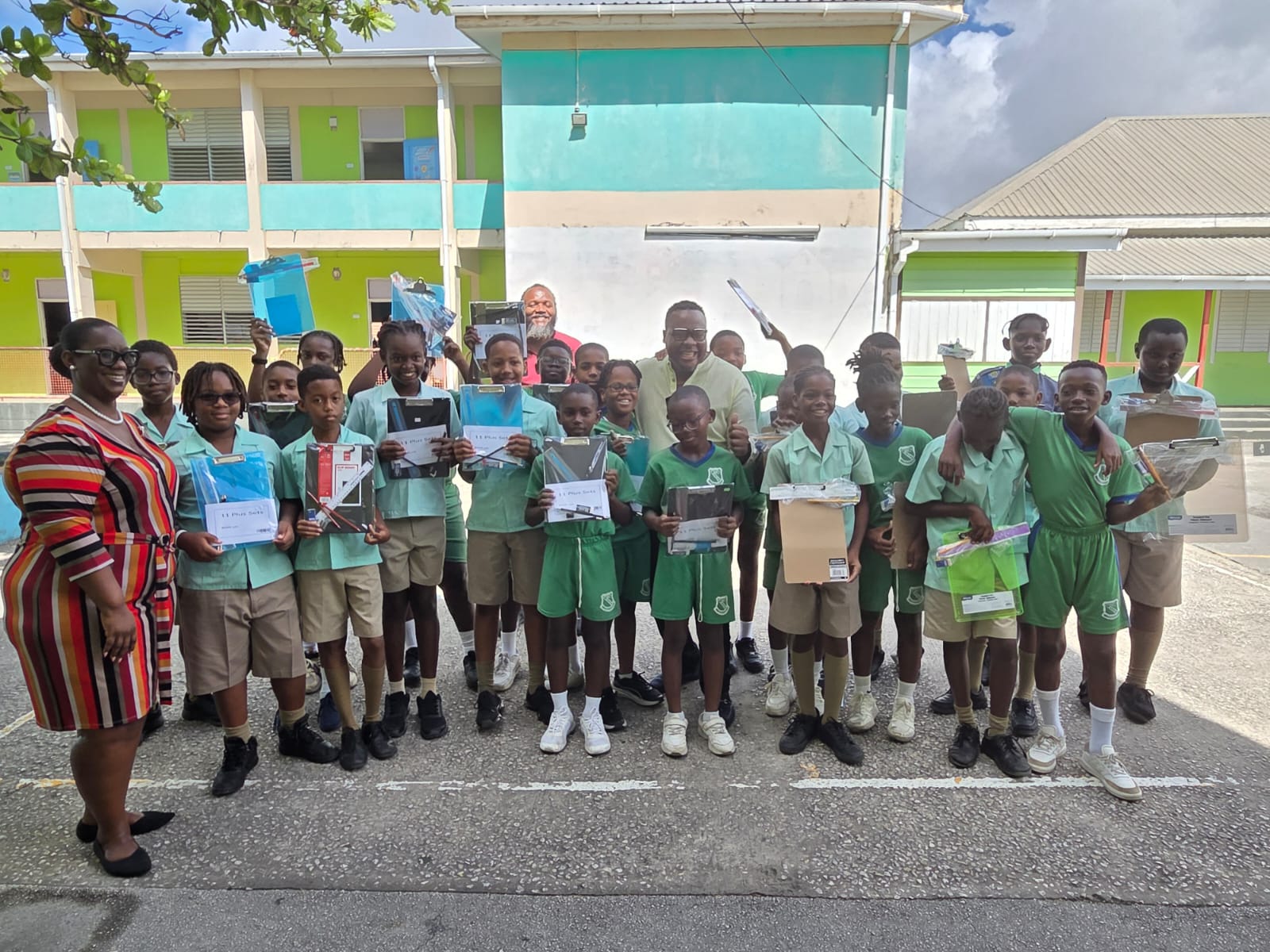
Founder of Trident Charity Quincy Jones takes a group shot with students at Milton Lynch Primary School in Christ Church
(RR)
The post Call for intervention after 11 plus mock exams reveals learning gaps appeared first on Barbados Today.