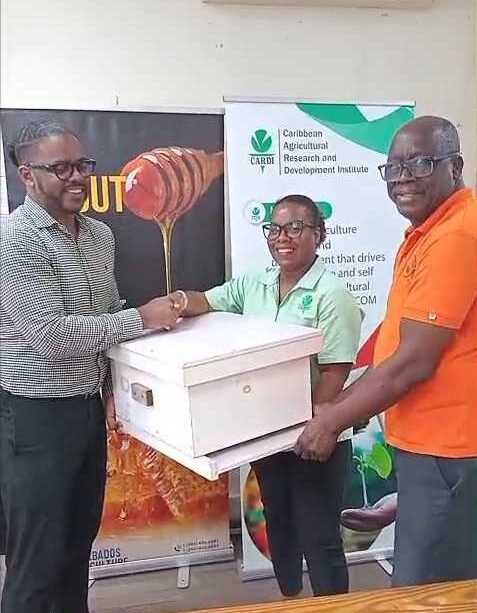
In a major step towards building agricultural resilience and safeguarding food security, the Caribbean Agricultural Research and Development Institute (CARDI) and beekeepers launched a major six-month project to introduce managed honeybee pollination services into mainstream Barbadian farming.
Unveiled on World Bee Day, the CARDI-Barbados Apiculture Association (BAA) Apiculture Pollination Services pilot will conduct rigorous scientific research on a one-acre agricultural site. Over the next several months, researchers will measure exactly how managed honeybee pollination improves the yield, quality and performance of local crops, focusing initially on cucurbits such as cucumbers, squash and pumpkins.
The initiative comes at a critical time for apiculture, which is currently grappling with skyrocketing import costs for equipment, praedial larceny and a changing climate. Recent widespread wildfires across Barbados have further devastated the industry, destroying managed hives and wiping out crucial bee foraging areas.
Speaking at the official launch, BAA president Graham Belle said that the project represents a strategic move towards smarter, data-driven farming that directly protects the livelihoods of Barbadian farmers.
“We gather today on World Bee Day, a day that serves as a profound reminder that pollinators are far more than just insects,” Belle stated. “They’re fundamental parts of our economic, nutritional, and environmental infrastructure in Barbados. This research is not just about honey production. It is about evaluating the economic and ecological value of agriculture as a service to mainstream agriculture. By investing in apiculture, we are choosing a path for smarter farming, we’re reducing our import dependence, and we’re laying the foundation for the Barbadian honey brand to become a premium product on the world stage.”
The pilot project is being funded through CARDI, which will provide ongoing financial and administrative resources, while the BAA delivers on-the-ground technical support. CARDI country representative Christina Pooler explained that the trial will serve as a vital catalyst to demonstrate the tangible benefits of bees to the island’s food systems.
Beyond tracking agricultural yields, the project will also assess hive health and monitor environmental pressures, including wind patterns and pesticide spray drift from surrounding communities.
“Globally, there’s an urgent need to increase the diversity and the number of pollinator species to contribute to our food system to make it more resilient and productive,” Pooler said.
“This project, therefore, will serve as a catalyst to demonstrate the economic and ecological value of apiculture with the data being generated to potentially guide future research and policy recommendations for apiculture in the island. By combining research with education, we aim to strengthen the link between science and practice, ensuring that farmers and beekeepers alike are empowered to safeguard the future of our food security.”
Pooler added that a substantial component of the six-month initiative involves hands-on sensitisation and practical logistical training. This training aims to bridge the gap between crop farmers and beekeepers, while simultaneously dismantling public phobias regarding bees.
The collaborative nature of the project earned strong praise from agricultural leaders. James Paul, chief executive officer of the Barbados Agricultural Society (BAS), welcomed the partnership, noting that the farming community has long been calling for this type of targeted, applied research to solve real-world production challenges.
“One of the things that we have always, always been calling for in the sector recently is that we do need research — an applied research in which research institutions try to work with our farming community,” Paul said.
“I really want to say that it’s good to see that researchers are taking the opportunity to work with farmers, understanding the challenges that they face and trying to improve on them. Many beekeepers in this country will be able to learn from the results of the research and to take advantage of it.”
As the trial gets under way, both CARDI and the BAA expressed hope that the data generated will establish a permanent, long-term framework for integrating managed pollination services into the nation’s farming strategy.
(RR)
The post Pilot integrates honeybee pollination into farming appeared first on Barbados Today.