
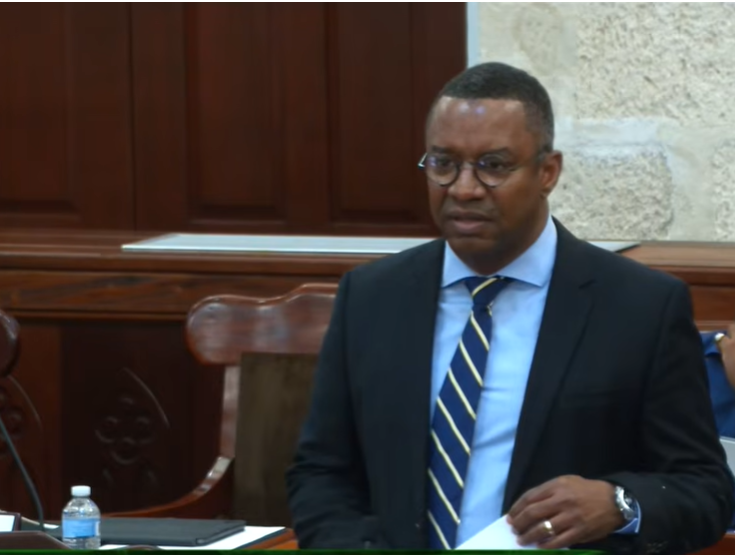
A new specialised firearms court introduced on Tuesday to fast-track gun cases, would reduce delays that allow accused offenders to secure bail and address mounting public concern over violent crime, Attorney General Wilfred Abrahams has told Parliament.
The Supreme Court of Judicature (Amendment) Bill creating a dedicated “gun court” is a direct response to a “confluence of national circumstances”, he said.
The legislation, which follows last week’s passage of rigorous anti-gang laws, was touted as a part of a broader legislative overhaul aimed at restoring public confidence in the island’s judicial system.
“Everywhere I go, I get it,” the AG said, reflecting on public pressure regarding national security. “If somebody is against the government, they say, ‘What are you all doing? Barbados has run away.’ If they are in favour of the government, they say, ‘Look, we know you are doing the best you can, but you have got to get this under control.’”
While acknowledging that an administration cannot directly control the actions of an individual who chooses to commit a crime, Abrahams stressed that the state has an absolute duty to safeguard its citizens by providing robust infrastructure, procedures and protocols.
He noted this includes the Barbados Police Service and executing joint patrols with the Barbados Defence Force (BDF), whose personnel are undergoing specialised training in civil police protocols to support domestic security operations.
A major driver behind the new court division is the need to curtail the ease with which individuals charged with firearm offences secure bail due to lengthy delays in the court system.
Noting that under the Constitution of Barbados, every citizen has a right to freedom and a corresponding right to a speedy trial, Attorney General Abrahams explained that when the prosecution fails to bring a case to trial or provide disclosure within two to three years, courts are legally obligated to grant bail, even for heinous crimes such as murder.
“A man is innocent until proven guilty. When people go before the court saying: ‘Look, I sat down at Dodds [prison] two years, nothing happened in my trial. I haven’t got disclosure yet,’ it is hard for a court that knows what the constitutional rights are to say to a man: ‘We can keep holding you indefinitely.’”
To correct this vulnerability, the government has mandated strict, compressed timelines for serious offences. Simple firearm cases must now be completed within six months, while more complex matters are expected to be resolved within a nine-month window.
The attorney general admitted that regional governments historically resisted establishing specialised gun courts because doing so required a public admission that firearm offences had reached a critical threshold.
“At one point in time, nobody wanted to do it because to create a gun court was to admit that there was a need for a gun court,” he said, adding that such political hesitation has been entirely overtaken by the government’s accountability to the electorate. “That horse has already bolted.”
By establishing the new division, Barbados follows the precedent set by regional neighbours Jamaica and Trinidad and Tobago. Under the new statutory provisions, the Firearms Court will hold absolute jurisdiction over all firearm-related offences, alongside any ancillary or peripheral matters assigned to it by the Chief Justice to prevent duplication of state resources.
Addressing the long-standing debate surrounding the death penalty, which remains on the statute books for murder and treason, the AG clarified the legal realities maintaining the country’s de facto abolitionist status.
He referred to the landmark Privy Council ruling in Pratt and Morgan, which established that keeping a prisoner on death row for more than five years constitutes cruel and inhumane punishment. Although Barbados now recognises the Caribbean Court of Justice (CCJ) as its highest appellate body, the five-year principle remains highly persuasive in regional jurisprudence.
“Because the legal and appellate machinery in Barbados routinely takes longer than five years to exhaust all legal remedies… capital punishment cannot lawfully be executed,” he explained, citing subsequent rulings.
He noted that even after domestic appeals are exhausted, defendants routinely petition international human rights bodies that intentionally delay proceedings to run out the clock. The new emphasis on swift trials aims to reform this sluggish appellate machinery.
The amendment introduces substantial operational flexibility to protect witnesses and maintain judicial momentum. The Firearms Court is legally empowered to sit at any location designated by the Chief Justice, including high-security facilities such as the prison, to mitigate the security risks associated with transporting high-profile gang members.
Furthermore, the law permits the use of video links and electronic hearings to insulate vulnerable witnesses from intimidation by associates of the accused.
The legislation also preserves a defendant’s right to a trial by a jury of their peers, but formally introduces the option for judge-alone trials to combat juror intimidation.
“The reality is that they are frightened,” Abrahams said regarding reluctant jurors. “You do not want to sit opposite Barbados’ most wanted… We have to embrace that a time is coming when judge-alone trials, especially for these types of offences, become more prominent.”
Crucially, the bill ensures that the rights of minors remain paramount. In cases involving children in conflict with the law, the provisions of the Child Protection Act and the Child Justice Act will maintain legal precedence over the new firearms legislation.
The attorney general asserted that the legislative framework would be continuously refined to eliminate any further loopholes identified by defence counsel.
“The length and the delays frustrate the victims, it frustrates the families, and it undermines confidence in our judicial system and the rule of law,” Abrahams said. “Where legislation needs updating, we will update. Where it needs amending, we will amend. We are trying to do what is right by Barbados.”
(RR)
The post Gun court aimed at speeding trials, closing legal gaps – AG appeared first on Barbados Today.