
Parents have been given their clearest picture yet of how Barbados’ proposed transition from primary to secondary school will operate, with classroom projects completed at school, four standardised tests spread over two years and continued parental choice of secondary schools all forming part of the new assessment model.
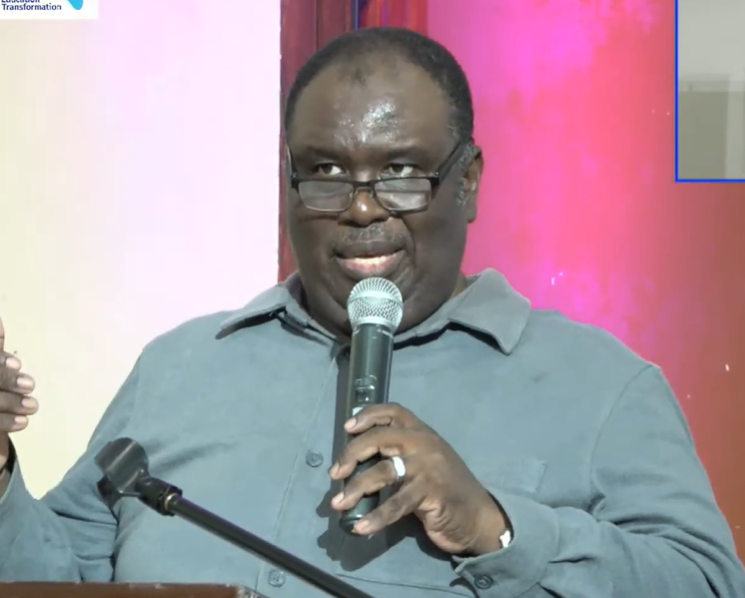
Deputy Chief Education Officer for Planning and Development Reverend Stephen Scott outlined the details during a Ministry of Education Transformation town hall meeting on Thursday evening, one of several public consultations being held following the government’s announcement that the traditional Barbados Secondary School Entrance Examination will be replaced by a new two-part assessment model.
The proposed system would move away from relying on a single examination and instead assess students over a two-year period through continuous classroom assessments and national standardised tests.
“The outline of the new transition model is that it will be a two-part approach,” Rev Scott said.
“There will be the first part being continuous assessment which will be worth 50 per cent of those marks and the second will be standardised testing.”
The new approach would allow students to demonstrate a wider range of abilities while reducing the pressure associated with a one-day examination, he said.
“As we engage in not doing the one-day examination but giving the students to engage over a two-year period to transition from primary to secondary school, it will allow our students to demonstrate strengths beyond the pen, pencil and paper.
“It will allow them to improve performance over time, and that will be reflected in the continuous assessment process. It will demonstrate skills that we all want our children to have and to emulate and to engage in creativity, collaboration and critical thinking.”
He added: “We will not be relying just on that one-day examination where sometimes our students do not do well on that examination because of several factors and we want to avoid such occurring.”
The continuous assessment component would centre on two classroom projects completed during Classes Three and Four, Rev Scott explained.
The education ministry will provide three project options, from which each school will select two. One project will be completed during the first two terms of Class Three and the second during the first two terms of Class Four.
Rev Scott stressed that the projects would be completed entirely at school.
“These projects will be done only at school. They will not be done at home,” he said.
“There will be a time in the timetable slotted for students to complete these assignments and to receive that instruction.”
Students will work collaboratively on the projects but will also complete an individual component that contributes to their final assessment.
“They will work together on that project that is chosen but then there will be an individual component that each student will complete,” Rev Scott said.
Teachers will assess the projects using ministry-issued rubrics outlining exactly how marks are to be awarded, while education officers acting as assistant examiners will monitor and moderate the process across schools.
“Our education officers… will visit the schools during the time that the projects… are being completed… to give guidance, where needed, to oversee the process,” Rev Scott said.
“They will review the projects and… engage in moderating, looking at that marking to make sure that it has followed the criteria in the rubrics.”
The remaining half of students’ placement scores will come from four standardised tests spread over the two years.
Students will sit English and Science examinations in the third term of Class Three, followed by Mathematics and Social Studies/Civics in the third term of Class Four.
Unlike the current Common Entrance examination, the tests will be written at students’ own primary schools.
“The students will not be going to the secondary school where it may be a strange environment.
“They are in their school and we will have persons to make sure that that process goes smoothly.”
Parents will continue to rank their preferred secondary schools, with placements determined by students’ combined performance in the continuous assessment and standardised testing components, as well as available places at each school.
Scott said the proposed model is also intended to give secondary schools a more complete understanding of incoming students.
“We do not want to make it arduous on our students,” he said.
“We want to make our students as comfortable as possible to engage in this process over the two years… because we want to ensure that it’s not just that we are assessing them but we are taking note of all of their skills, the talents and other aspects as we build a profile for our students.”
That profile would allow secondary schools to better understand students’ strengths and support their development from the moment they enter the new learning environment.
The town hall formed part of the ministry’s ongoing public consultation on the proposed transition model, with parents invited to provide feedback before the framework is finalised.
Proposed primary-to-secondary transition model – What to Know
How will students be assessed?
- 50 per cent Continuous classroom assessment
- 50 per cent National standardised testing
How many projects will students complete?
- The ministry will provide three project options.
- Schools will select two.
- Students will complete one project in Class Three and another in Class Four.
Will projects be done at home?
- No. All projects will be completed at school during scheduled class time under teacher supervision.
Will students work individually?
- Projects will include both group work and an individual component.
What subjects will be tested?
- Class Three (Term 3): English and Science
- Class Four (Term 3): Mathematics and Social Studies/Civics
Where will students write the tests?
- At their own primary schools rather than at secondary schools.
How will fairness be ensured?
- Teachers will mark projects using Ministry-issued rubrics.
- Education officers, acting as assistant examiners, will monitor schools and moderate the marking.
(SM)
The post New model aims to build fuller student profiles for secondary schools appeared first on Barbados Today.