The University of the West Indies at Cave Hill is expanding medical ethics training to emphasise doctors’ professionalism and patient engagement, as medical training seeks to meet the evolving needs of healthcare, its dean of medicine said on Friday.
As the 25th Sir Errol Walrond Scientific Symposium opened at the Queen Elizabeth Hospital, Dean of the Faculty of Medical Sciences, Dr Damian Cohall, said the faculty continues to develop its programmes to meet the evolving needs of healthcare while preparing graduates for modern medicine.
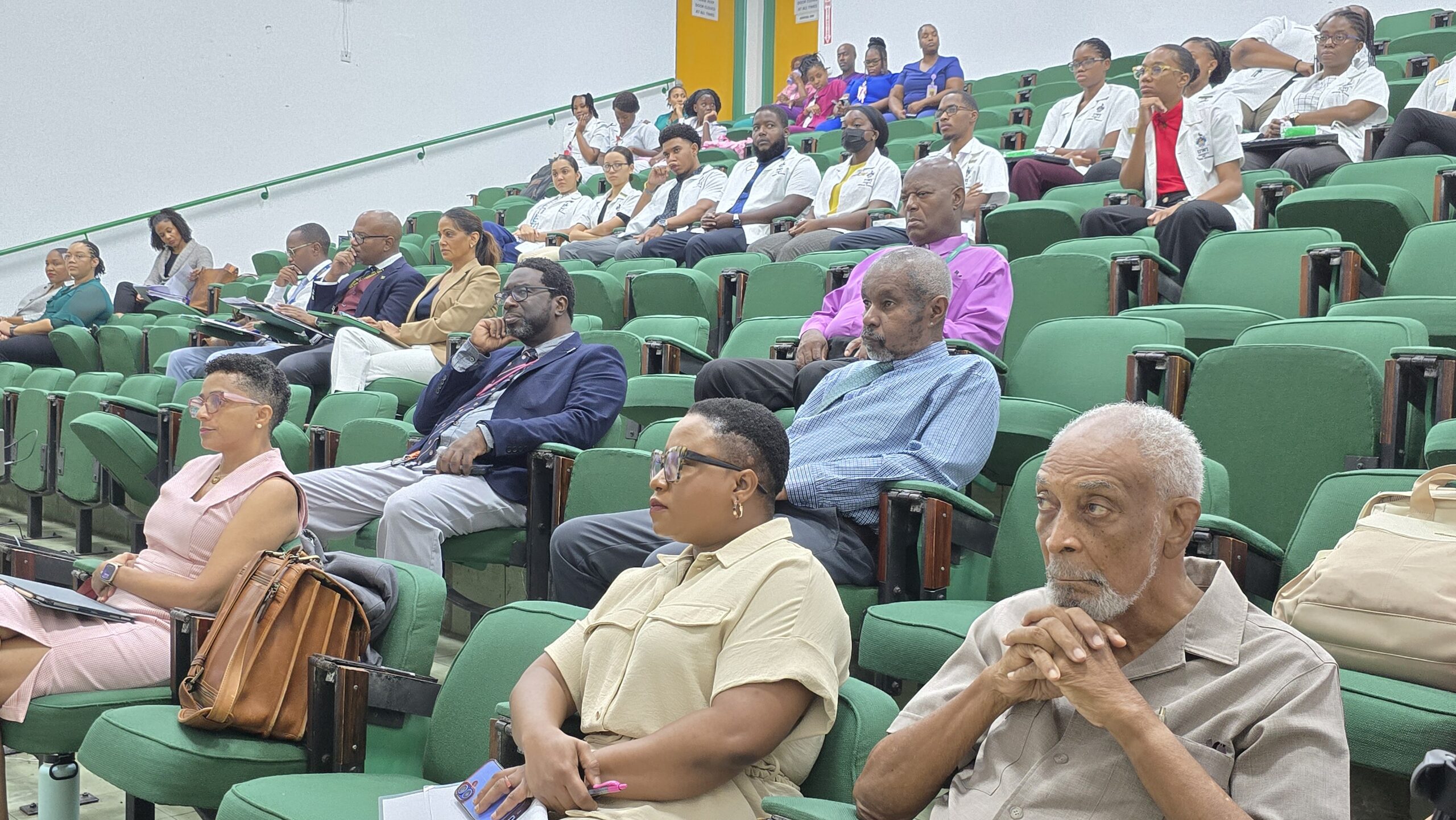
Medical Practitioners, Hospital Officials were sitting in on the Sir Errol Waldrond Symposium. (Photo Credit: Lourianne Graham)
Dean Cohall revealed that ethics has been strengthened in the undergraduate curriculum by adding two credits at the Year Four level:
“Ethics is now a formal part of our training, not that it wasn’t there before, but we have reemphasised the importance of ethics by adding an additional two credits to one of our structures at the Year 4 level. To make sure that as our undergraduate students go through their training, by the time they hit Year 5, ethics, again, is reemphasised.”
He said the changes came in response to feedback from government, the public and other stakeholders, as greater emphasis is being placed on strengthening doctor-patient engagement and professionalism.
“We have certainly heard some of the comments from our key stakeholders, government and the public, about the face of medicine and the engagement between our trainees, both undergraduate and postgraduate, and patients in the clinical space and beyond.
“We have looked internally at our programmes and made the necessary adjustments to ensure that we stay true to our purpose and that the engagement between the public and our healthcare practitioners, especially those who are in training, is on point.”
Dr Cohall also announced that ethics conferences are now mandatory for undergraduate and postgraduate students and have attracted participation beyond the university.
“Our ethics conferences have now become mandatory according to faculty standards for undergrad and postgrad students, and I’m happy to report… that over the last two ethics conferences that we have had, we have had attendances of over 160 participants, which certainly goes beyond the number of trainees that we have. It means that we’re also attracting other persons, other clinicians, other practitioners, to those conferences.
“We don’t want this only for our medical students, but I see the nurses here.”
The medical dean also highlighted efforts to strengthen the faculty’s research infrastructure through partnerships and investment in research projects:
“We have certainly benefited by collaborating with other important partners, for example, the Sick Kids Initiative, where we have the Shaw Centre of Pediatric Excellence; there’s ongoing work. We’ve recently appointed a research fellow who is funded through that initiative. We have five catalyst grants which are currently ongoing, bringing again cutting-edge research projects and programmes not only within the academic space but also in the public.”
He also encouraged medical residents to pursue research that influences policy and clinical practice rather than simply generating data:
“One of the key gaps that we have noted and we have spoken about this many times is that we want transformative research from our residents, right? We’re going to hear some presentations today, but we want transformative research, not just research where we count beans.”
Dean Cohall said he hopes the research presented at the symposium will not only be published but will also contribute to improving healthcare delivery and clinical practice.
Minister of Health Senator Lisa Cummins said:
“This is about research; this is about medical ethics; this is about the future of healthcare; this is about how policy and ethics and empirical research and implementation of rationalisation all collide to be able to lead to a given outcome.”
She challenged researchers to consider the role they play in developing solutions to today’s healthcare problems and their legacy at the symposium, named for legendary surgeon Sir Errol “Mickey” Walrond:
“What is the role of the people in this room in developing solutions to solve today’s problems? How do you stand in the shade of Sir Errol Walrond, by your own contribution and paved the way, I call it the institutional scaffolding for those who will come behind you to stand in your shade by your own contribution?”
The minister warned against losing sight of the people that healthcare systems are meant to serve:
“Why is it important and who that research is for? Because anytime we lose sight of the people on whose behalf we work, we research, we shape policy, we introduce interventions, and we reform systems and structures, we’ve lost sight of the plot.”
She also pointed to artificial intelligence, genomics, robotics and climate change as forces transforming healthcare:
“We’re not in a vacuum in an age where all of these innovations, these interventions are changing in a rapid speed. Artificial intelligence is already reshaping what we do. Genomics is rewriting what precision means, robotics is redefining the operating theatre, and climate change is creating public health emergencies that many of our textbooks historically never considered and never conceptualised.
“So let me be plain, change is happening. Change is already here, and more change is still to come.”
(LG)
The post UWI expands ethics training as healthcare evolves appeared first on Barbados Today.