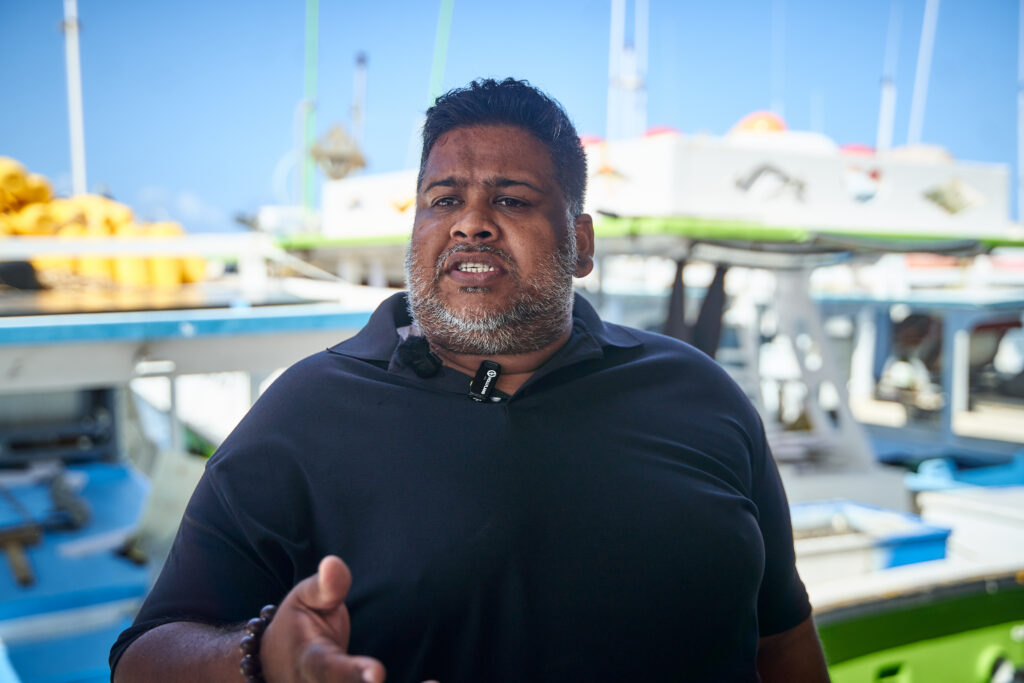

Reprising a catchphrase to sum up the Caribbean’s position in the current geopolitical environment, Professor Justin Robinson has warned the Caribbean that as global trade fractures, foreign powers will not rescue small island nations, stressing that self-reliance and genuine regional unity are an absolute necessity.
“As I’ve spent the last year annoying the Caribbean public with a single message that ‘no one is coming to save us’, that’s true, and we have to do this ourselves, he told the Central Bank of Barbados 46th Annual Review Seminar, held at the Lloyd Erskine Sandiford Centre.
The economist who is principal of the UWI at Five Islands in Antigua, challenged the region’s habit of waiting for international markets to fix themselves. The era of relying on external economic safety nets is over, he suggested, urging Caribbean societies to undergo a fundamental psychological shift to take full control of their own financial destinies.
For decades, small Caribbean states have operated within an international trading system built entirely by larger, wealthier countries. Rapid globalisation allowed small economies to access foreign goods and services, but forced these economies to be heavily reliant over the global economic powerhouses .
As the global economy now splits into competing trade blocs, with major powers turning towards protectionism, tariffs, and supply chain nationalism, the Caribbean finds itself particularly exposed. But Professor Robinson suggested that this global fragmentation should not be viewed as an unprecedented surprise, but rather as a return to historical norms.
”I see the issue in political economy terms and in somewhat psychological terms because the Caribbean didn’t build the global trading system that is currently fragmented. We were incorporated into it on other people’s terms. So fragmentation is really not a departure from our history, it’s really a return to the normal condition.”
He pointed out that the global trading architecture was never designed with small island states in mind. When a large industrial economy introduces trade barriers, it suffers a minor loss in efficiency. However, when small island nations face trade disruptions, the stakes are far higher and hit immediately at the baseline of daily survival.
”When large economies fragment, they lose efficiency. But when small economies like ours are fragmented against, we really risk actually losing viability, and I think this is really what is at stake for us at this point.”
The real-world impacts of this global shift are already arriving on local shores in the form of higher prices for everyday items. Because Caribbean nations import the vast majority of their food, fuel, and consumer goods, external disruptions translate directly into domestic cost-of-living spikes.
Professor Robinson said: ”The current situation is urgent because the costs are real, they are already arriving. A 0.5 per cent increase in inflation is a data point in large economies. It’s the difference between making your groceries in most of our islands, so the costs are already here.”
At the same time, historical escape valves that once cushioned Caribbean economies from domestic hardship are rapidly disappearing. For generations, regional development models relied heavily on outward migration and the flow of financial remittances from citizens living abroad. As key countries in the Global North implement stricter immigration policies and tighten borders, these traditional safety nets are shutting down.
Professor Robinson continued: ”I see it as a compound, as really a crisis of our whole development model, which relies, which is heavily externally dependent. Migration options are closing. So our own failure to develop has been cushioned by the fact that we could export people. That gap is closing. The remittances from those persons again have supported levels of consumption that our economies cannot support.”
Highlighting this reality, Professor Robinson explained the psychological hurdle the region must overcome if it hopes to survive these compound shocks:
”I think the question is whether we respond as we always have, waiting, adjusting, absorbing—or whether this is the shock that finally forces us to make the choices to build something more resilient.”
To survive this new economic reality, Caribbean nations must transform regional integration from an ideological sentiment into an everyday practical tool, he argued. He noted that despite CARICOM member states having signed numerous trade agreements on paper, significant obstacles continue to hinder actual commerce between them.
High transport costs, complex border bureaucracy, uncoordinated port operations, and conflicting product standards make it excessively difficult for businesses to trade with nearby neighbours, he added.
”Regional integration is not a panacea for our problems, but it is one of the areas we have where we can respond and somewhat reduce our vulnerability and negative impact. So regional integration is really no longer a sentiment, I think it becomes a necessity.”
Fixing these internal friction points requires direct action from national governments and regional institutions, the economist said.
He called for priority to be given to modernising port operations, streamlining customs clearance, and harmonising trade standards across the region. Building strong domestic connections – such as directly linking local farming and manufacturing to the foreign exchange generated by the tourism industry – offers a clear route to keeping money within communities and reducing reliance on expensive imports, he argued.
Professor Robinson highlighted the Organisation of Eastern Caribbean States (OECS) as a practical example of how smaller nations can successfully integrate out of sheer necessity. Because of their tiny size, these sub-regional states established true free movement of labour, shared regulatory frameworks, and a common Supreme Court.
He said: ”The OECS states, I think because of the micro nature of those countries, they don’t have a choice but to integrate, and they have levels of integration that are not present in the rest of the region… They have genuine free movement of labour in the OECS, they have a single Supreme Court, and I think that comes out of the fact that because of their small size, they view integration as a necessity.”
(RR)
The post ‘No one will save us’: Caribbean must be self-reliant for economic survival – professor appeared first on Barbados Today.