
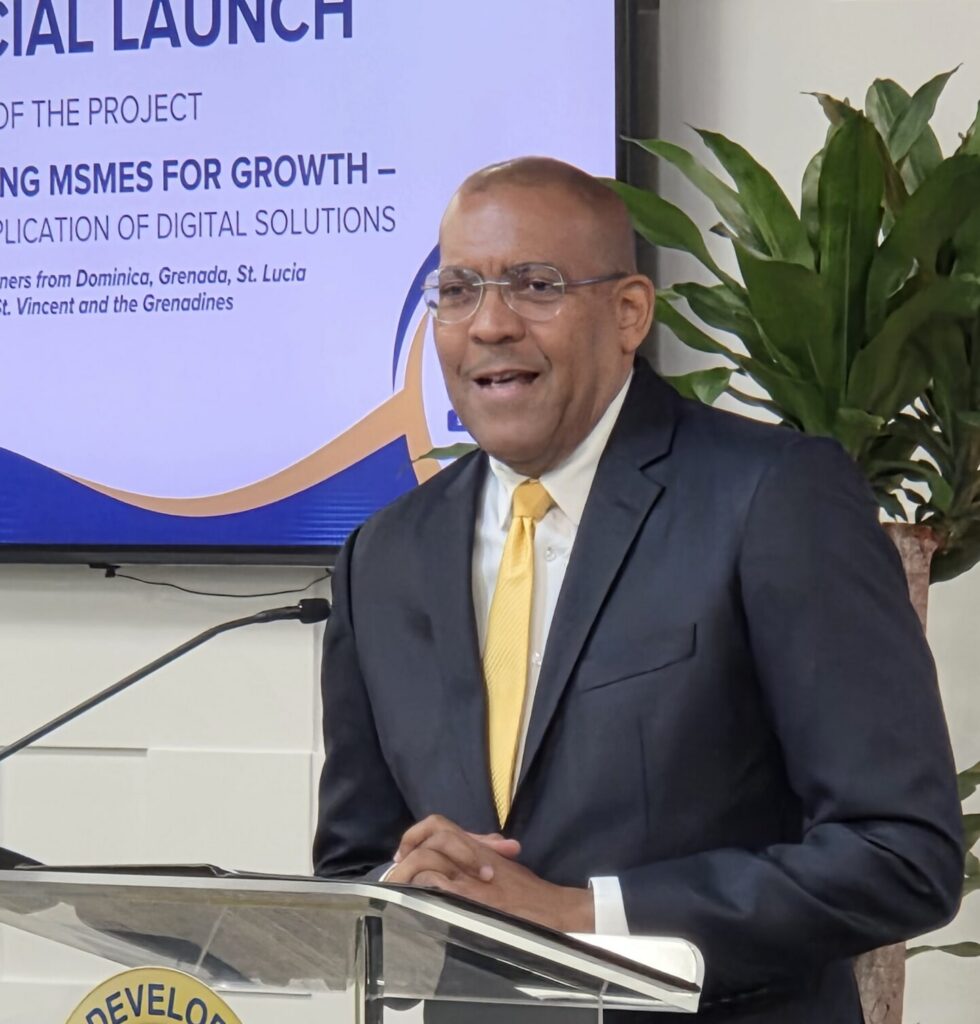
The Caribbean is lagging behind North American markets in digital commerce, with only four to five per cent of business transactions in the region being conducted digitally, Senior Minister Kerrie Symmonds has warned.
The business development and consumer affairs minister said the figure compares with about 18 to 19 per cent in the United States and 16 per cent in Canada – markets he said Caribbean businesses should be seeking to penetrate.
He suggested the numbers should force the region to examine its approach to digital transformation.
“We are again informed that we are being a little bit sluggish, when we recognise that 70 per cent of the retail trade in this region is still done in the traditional stores,” Symmonds said.
He said the challenge was not simply one for individual small businesses, but required a broader policy response to encourage greater use of digital and mobile transaction-based commerce across the region.
The senior minister was speaking at the Small Business Association’s capacity-building project launch, titled Reengineering MSMEs for Growth – Adoption and Application of Digital Solutions to Build Resilience and Global Competitiveness, and the launch of Small Business Week at the Caribbean Development Bank (CDB).

(From left) Head of Country Barbados CIBC Caribbean, Victor Boyce, SBA’s First Vice Chairman, Donna Hope and President of CDB Daniel Best. (Photo Credit: Jenique Belgrave)
Noting that some businesses may be too risk-averse or conservative in adopting new technologies, he warned they would have to become more competitive to grow.
Symmonds said this was necessary, noting that 98 per cent of these businesses contributed $5bn to the country’s $16bn economy, which he believed suggested they could contribute more.
The minister identified payment systems as a major obstacle to digital commerce in the Caribbean, particularly for businesses trading across borders.
“And in this geopolitical environment, where we rely so heavily on externally based structures for payment, then the line can be cut, either severed or blocked, and therefore the ability to do the transaction becomes frustrating. And the policy intent is clear; the desirability of it is there, but you cannot deliver. If a business cannot sell, or can sell but can’t be paid, the business cannot survive, and that is really where the challenge lies,” he said.
Saying that Caribbean consumers have largely gravitated towards traditional credit and debit cards because they provided confidence and consumer protection, he also warned that the region’s reliance on externally controlled payment systems came at a cost through high processing costs, interchange fees and interest rates. In Barbados, he noted, these reached around 24 to 25 per cent.
The senior minister also raised concerns over large numbers of Caribbean people who remain unbanked or underbanked.
It’s estimated that between 30 and 35 per cent of the CARICOM population may be unbanked, while another 40 to 50 per cent may be underbanked. In the OECS, the unbanked numbers stand at between 20 and 25 per cent. Symmonds said the figures represented a serious impediment to the digital transformation being pursued.
The lack of interoperability between digital wallets was another concern, he said.
“So in a region with zero interoperability or just about zero interoperability, the merchant is using wallet A, and I am the customer, but I am using wallet B. I can’t do business with the merchant, and so therefore, as much as I have been approached by the MSME in question, and as much as I have bought into that which they wish to sell and want to do business with them, if my wallet can’t talk to his wallet, then nothing can happen.”
He said the problem required a regional rather than country-by-country response.
“It has got to be a holistic approach that treats to these matters across this region, and not just by country by country either.:
Symmonds also challenged MSMEs to examine their own resistance to adopting digital management systems.
While 78 per cent of businesses reported using social media and customer-facing platforms, only 14 per cent were using digitised inventory management software, 13 per cent were using payroll software, eight per cent were using customer relationship management software, and 25 per cent reported having no digital management tools, he revealed.
He said the figures suggested businesses were embracing technology to interact with customers but were slower to adopt systems that could improve efficiency, productivity and competitiveness.
Symmonds said businesses cited the cost of digital tools and a lack of knowledge about how to use them as reasons for their reluctance, but he warned that remaining “informal”, “analogue” and “digitally immature” would limit the ability of MSMEs to contribute to the new economy.
“While we may argue about whether that is a reasonable answer or whether that answer is something that you can’t agree with, what you cannot do is to disagree with the consequences. The consequences are that there are still, therefore, too many of our MSMEs, which are locked into a state of being very informal and being analogue, and therefore being digitally immature and digitally underdeveloped, and in that state, they cannot give birth to the new economy that we want to be able to create through the application of the digital solutions that we’re talking about here today.”
Symmonds said governments and regional institutions must develop policies that meet businesses where they are and help lift all enterprises towards greater regional inclusion.
CDB President Daniel Best said the Caribbean could not afford to remain on the sidelines of the digital economy.
He praised the project, which will see 150 MSMEs across Barbados, Dominica, Grenada, St Lucia, and St Vincent and the Grenadines strengthen their digital capabilities, adopt new technologies and become more competitive in regional and international markets.
Best said: “The Caribbean cannot afford to remain on the sidelines of the digital economy, but participation will not happen by chance. This is not a pipe dream. It requires entrepreneurs who are ready to adapt, institutions that are ready to support them, and partners who are prepared to invest in the systems that make digital business possible.
“So I want to invite every participant in this initiative to use it fully, build the skills, adopt the tools, strengthen your systems, and pursue the markets that digital transformation can and will open for you.”
The project would translate opportunity into growth by placing inclusion at its centre, supporting women-led enterprises and underserved businesses that face additional barriers to expansion, the CDB president said.
Best said technology was reshaping how businesses create value, conduct trade, and compete, giving Caribbean businesses an opportunity to overcome some of the traditional constraints of operating in small states.
“For small states and firms, digitalisation offers a powerful opportunity to overcome traditional constraints, strengthen resilience, increase productivity, and expand participation in regional and global markets.”
But he pointed out that knowledge was not enough, adding that the project included grant support to help selected entrepreneurs implement their digital transformation plans and, by extension, scale their businesses.
Noting that research commissioned by the Small Business Association and funded by the Inter-American Development Bank in 2025 found that MSMEs accounted for 98 per cent of formal businesses in Barbados and 55 per cent of private-sector employment, SBA vice-chair Donna Hope said the initiative was particularly important given the contribution of MSMEs to the economy.
“These figures reinforce a fundamental point: when our small businesses are stronger, more productive, and more competitive, our economies are stronger,” Hope said.
The theme for Small Business Week 2026 is Beyond Borders: Positioning Small Businesses for the Global Economy.
(JB)
The post Caribbean digital commerce falls behind North America – minister appeared first on Barbados Today.