
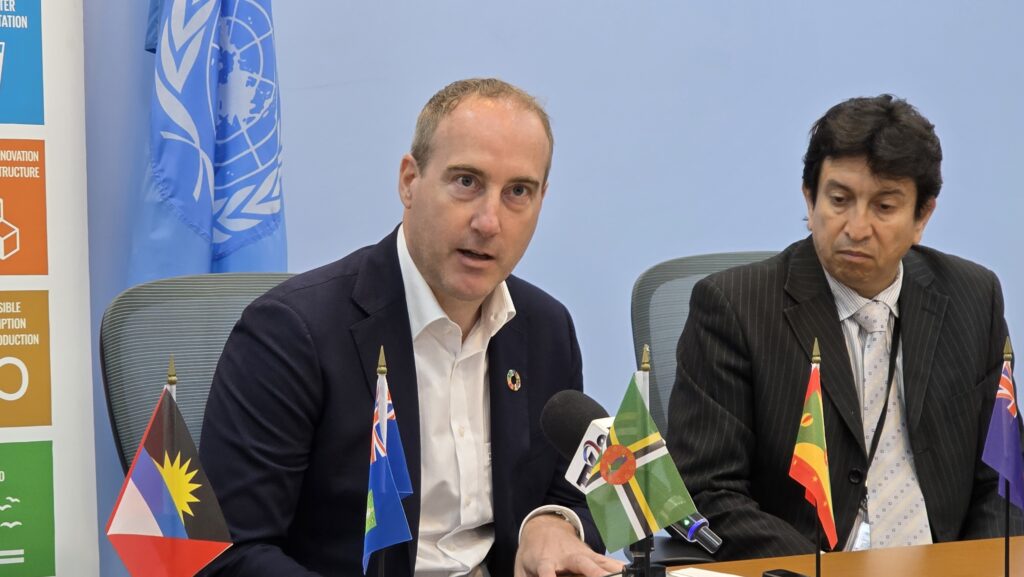
Caribbean nations, faced with shrinking populations and growing labour shortages, are reevaluating migration policies as a key pillar of economic survival, the top United Nations official on migration in the region said on Tuesday.
Patrice Quesada, Caribbean regional coordinator for the International Organisation for Migration (IOM), said CARICOM member states are currently developing a regional migration policy aimed at addressing labour mobility, demographic decline and climate-related displacement.
As the UN launched its 2025 Eastern Caribbean report, Quesada said declining demographics were affecting countries throughout the region, while labour shortages continued to place pressure on critical sectors.
“Some sectors are in stress in most of the countries. You can think of construction, the health sector and tourism,” he said.
Migration policies would also need to reflect the specific development needs of individual countries, he added.
“The discussion has matured to a point that governments are looking at it as a development strategy. What migration could bring in addition to skilling in the agricultural sector, for instance, to help meet the need and supporting food security.”
Quesada said the UN’s role was to support member states through the process, noting that migration and demographic decline were now being recognised as major regional trends shaping the Caribbean.
“Migration is part of the cooperation framework and is recognised there alongside demographic decline as one of the mega trends that is shaping the Caribbean.”
He also pointed to St Lucia’s upcoming national migration policy launch as a possible model for other Caribbean countries.
“That was seen as a pilot of how countries in the region could develop through an all-of-society, all-of-government approach, something that will fit the specific needs of each country because while we see that there are trends across the Caribbean.”
Governments were still in consultation about what changes would need to be incorporated into the implementation of a regional migration framework, Quesada said.
“What does it mean to integrate someone in society? How to make sure it’s a win-win? How to make sure that instead of having people that come in an irregular way and that do not pay taxes, but that also exploit them, that expose themselves to exploitation, do you ensure that you have regular pathways so they contribute to the tax system and that they help the economy to grow? That’s the type of questions that the member states have in front of them right now.”
Quesada also pointed to climate change as another major driver of migration within the Caribbean:
“Part of the current structure of the migration policy that has been developed by CARICOM is looking at the climate change impact because besides demographic decline, climate change is probably the second biggest driver or mega trend affecting the Caribbean.”
While rising sea levels remained a concern, Caribbean countries were more immediately vulnerable to displacement caused by extreme weather events such as hurricanes and droughts, the IOM official noted.
“More acute for the Caribbean is displacement situations that are related to extreme weather events, and we think about hurricanes, but you can also think, and we will have to see what happens this season, droughts and drought situations across the space.”
Quesada referred to outward migration from Dominica following Hurricane Maria, as well as Barbuda’s inability to fully recover after several hurricanes.
“We know that those impacts are also there and we know that there needs to be discussion not only on how to address that from a humanitarian or disaster response standpoint. That’s the work that the UN is doing with [the Caribbean Disaster Emergency Management Agency] (CDEMA), for instance, with member states who have protocols for people moving from one island to another during an extreme weather event during a big hurricane for instance, but also more long-term types of strategy on recovery, on ensuring that people have a choice instead of migrating.”
Quesada stressed the need for more long-term regional discussions on climate resilience, urban development and vulnerable infrastructure.
“The whole impact on coastal areas and urban development as well, because that’s where the infrastructure are exposed, is also a mobility impact of climate change that needs to be looked at.”
(LG)
The post CARICOM weighs migration overhaul appeared first on Barbados Today.