
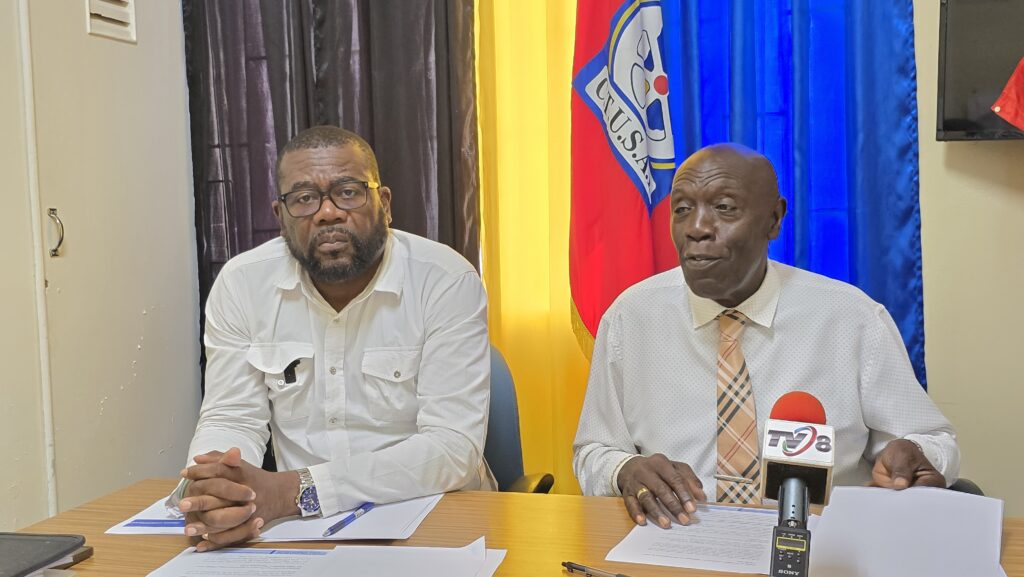
As Barbados grapples with escalating crime and violence, the Congress of Trade Unions and Staff Associations of Barbados (CTUSAB) is raising concerns about the treatment of members of the protective services, warning that delayed payments, inadequate insurance coverage and unresolved allowances are undermining morale and productivity.
The concerns were raised by CTUSAB General Secretary Dennis De Peiza during a press conference at the organisation’s St Michael headquarters on Thursday.
De Peiza criticised what he described as the government’s slow response to longstanding issues affecting public officers, arguing that the delays are having far-reaching consequences.
“This congress is very conscious of the fact that the slow responses by the government in addressing what should be termed the condition of public offices has a rippling effect that starts with a decline both in morale and productivity. You know, when those two things collide that cripples the output, as we say, and it has a lot of implications for the commitment of persons,” he said.
He added that delays in addressing conditions of service were also undermining public sector reform efforts and making careers in the sector less attractive to younger workers.
De Peiza warned that unresolved concerns could worsen recruitment challenges across the protective services and other areas of government.
“We have to be very conscious that there has to be a different approach to how we are engaging and trying to outreach to the persons who are currently in the system and those who are on the fringes of coming into the system.”
“Where it appears that there are inadequate conditions of service that are played within sectors of the public service, this could lead to a problem of filling vacant posts in central government and in SOEs.”
He continued: “Added to this would lead to brain drain, as many young graduates from the University of the West Indies and other tertiary institutions, I might add, would opt for employment overseas, where there are more favorable conditions of service that have been offered.”
The CTUSAB general secretary pointed to concerns raised by members of the protective services regarding delayed salaries, increments and acting appointments.
He referred specifically to complaints raised by the Barbados Police Association regarding outstanding payments to police recruits and concerns raised by prison officers over unpaid acting appointments.
“The Barbados Police Association has echoed its concern with down payment of an increment due to new recruits. This specifically relates to a group, those who are capable of the courses 144 at the training school in that area where then you have the situation where the prison officers is also voicing his concern about those who are acting appointment at the prison that does who are not being paid.”
De Peiza argued that officers tasked with protecting the public should not be left waiting for salaries and benefits that are due to them.
“These are people who we have, we put on the front line. These are people who we expected to, to protect, to serve and to be there to ensure that national security and the safety and well-being of the wider national public is, secured, but yet we don’t pay them or we pay them late and these are matters that people, I believe the general public will say this isn’t right.”
He also expressed disappointment over the lack of progress in providing personal accident insurance for frontline personnel.
“One would have thought that, given all the concerns about what’s happened to our country now, exceedingly high levels of crime and violence being perpetrated, and people who are putting themselves at risk on the front line. The police at risk, the people in the prison,… the nurses.”
Such protection was not a luxury but a necessary measure for workers who place themselves in harm’s way, De Peiza said.
“We must take this thing seriously to understand that this is just not a call to give people something for giving them sake, this is something that we will have to recognize is more than reasonable in terms of what it would do to build in that morale and esteem and give a level of comfort and a greater commitment to service by those who have given themselves and placed their lives and their families’ welfare on the frontline.”
The CTUSAB head also highlighted concerns over unpaid allowances for police officers, citing provisions under the Police Allowance Regulations.
“The Police Regulation 7 provides for payment for members of the force, drivers of vehicles, riders of horses and motorcycles. That these have to be paid the driver’s allowance, that this is not being done.”
He further pointed to allowance issues affecting prison officers, noting the significant physical and psychological risks associated with managing inmates and responding to violent situations.
De Peiza said the government must ensure existing regulations are implemented and properly monitored.
“These are things that if they are in the regulations, why are we not honouring what we have as the means of determining how we function, and I’m saying to us, to our media and to our public and to those who have to manage the affairs of our public offices wherever they are, let’s get more serious about it. Let’s put the systems in place and let’s monitor them and let’s ensure that what is to be done is done.”
The trade unionist also called for a review of restrictions affecting nurses seeking training opportunities.
“If we want to improve on the capacity of our nurses, I’m talking about the professional capacity, they must be exposed to training and retraining. We can’t talk about building a workforce that is capable of delivering excellent service, but you don’t train the people and we are complaining on behalf of the various nurses’ associations.”
He urged greater support for nurse education programmes, particularly at the Barbados Community College.
“We are making that call again for the authorities to recognise the importance of having an increase in nurse education, particularly because this is the key area, nurse education, so, to be established, particularly at the Barbados Community College where we train our nurses.”
At the same time, De Peiza reported progress in resolving concerns about medical services for members of the Barbados Fire Service.
“We’ve had some problems with medical services for members of the Barbados Fire Service, but our understanding is that this matter is being resolved and hopefully this will not be a concern to be echoed in the public domain going forward.”
Meanwhile, CTUSAB President Ryan Phillips welcomed government’s proposal to establish a gun court, describing it as a potentially useful measure in tackling firearm-related crime.
“We see it as a viable option if the nation is to push back on trafficking, possession, the assembling and importation and the use of firearms. Appropriate ways and means be found to eradicate the island of this particular threat and menace, especially when it comes and we look at the whole issue of public safety.”
Phillips also welcomed plans to train Justices of the Peace in arbitration, mediation and conciliation and suggested similar opportunities should be extended to trade union leaders and human resource professionals.
“Whereas CTUSAB is supportive of such initiatives, it shares the view that training should be extended to trade union leaders and human resource personnel as professionals in advanced mediation techniques to the scale tensions within our communities.”
“It can be argued that with advanced training, trade union leaders utilizing their existing knowledge, experience in conflict resolution, grievance handling, hearing of disciplinary matters, skilled and competencies can be well positioned to effectively deliver alternate dispute resolution services,” he added.
(LG)
The post CTUSAB: Frontline security workers being short-changed appeared first on Barbados Today.