A government-funded hurricane strap programme has already reached more than 2 000 households, with officials pledging to expand the initiative as increasingly intense storms heighten concerns about the resilience of homes across the island.
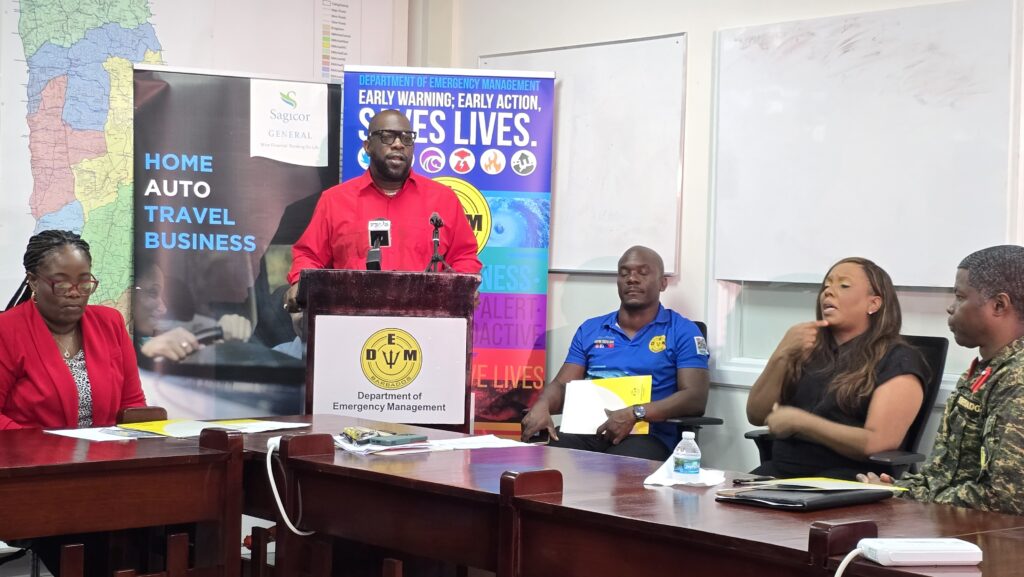
During Monday’s launch of the 2026 Atlantic hurricane season, Minister of Home Affairs and Information Gregory Nicholls said:
“This government has spent over $300 000 since November 2022…so far, over 2 000 households have benefited from the affixing of those straps to roofs. It is a program being conducted between the Ministry of Home Affairs, which has responsibility for disaster preparedness, and the Ministry of Housing, Lands, and Maintenance.
“We are going to continue to roll out the delivery of those hurricane straps to those persons who need them, but every carpenter, every builder, every contractor will tell you the importance of strapping your roofs.”
Teams remain available to install the straps for homeowners who need assistance, Nicholls said.
“The government has spent the money on acquiring the housing straps, and we are going to do our best to make sure that we can make your roofs in your homes more resilient and more sturdy is a programme that the government is committed to doing.”
He stressed that the hurricane straps are being provided free of charge to qualifying homeowners:
“Of course, if you have the means to acquire them on your own and to pay for the installation that is always available as an option, but for those who do not, or who have difficulty in assessing them, or even finding out about them, that is why this program was designed to ensure we can build resilience at the very, very level of the homeowner, so we are acting to make sure we can build that resilience.”
The Government Information Service and the Department of Emergency Management are to work together to raise public awareness about the initiative, said the information minister.
“I’ve asked the Government Information Service to partner with the DEM to make sure that Barbadians become even more aware of this operation.”
Nicholls also raised concerns about the design of some modern homes and their ability to withstand severe weather.
“There is a general concern that the roof structures that was built in the 1980s for example, carries that same design has moved away from the more gable type shaped roof that was built with the ability to be able to allow the air pressure to move throughout the house without damaging the roof, and we’ve seen a lot of modern designs after houses in Barbados recently without the overhang roof that had become prevalent in the 60s, 70s, 80s, and 90s.”
He said the hurricane strap programme forms part of the government’s broader effort to improve resilience at the household level.
“So there is an awareness for Barbadians, the builders and homeowners are modernising and trying to build more resilient roofs. That is why this government has expended, as I said, over $300 000 and is making available the operations to strap it to make sure that we build that resilience capacity, and that is one of the moves that the government has made.”
The initiative has become increasingly important as storms strengthen more rapidly than in previous decades, Nicholls said.
“We are acting to make sure we can build that resilience at the same time we know that the strength and the intensification that we have seen in a short period of time, as explained by [Barbados Meteorological Services director Sabu Best], that we have seen where tropical storm is on a horizon the day before, but it is a category five on the following day, that level of intensification, the rapid rate of intensification is something that we are seeing now as a new phenomenon, we are not going to be able to create a situation where all houses all over the island can can resist a hurricane, but we need to make sure that we communicate with people.”
(LG)
The post Govt expands hurricane strap programme to strengthen roofs appeared first on Barbados Today.