
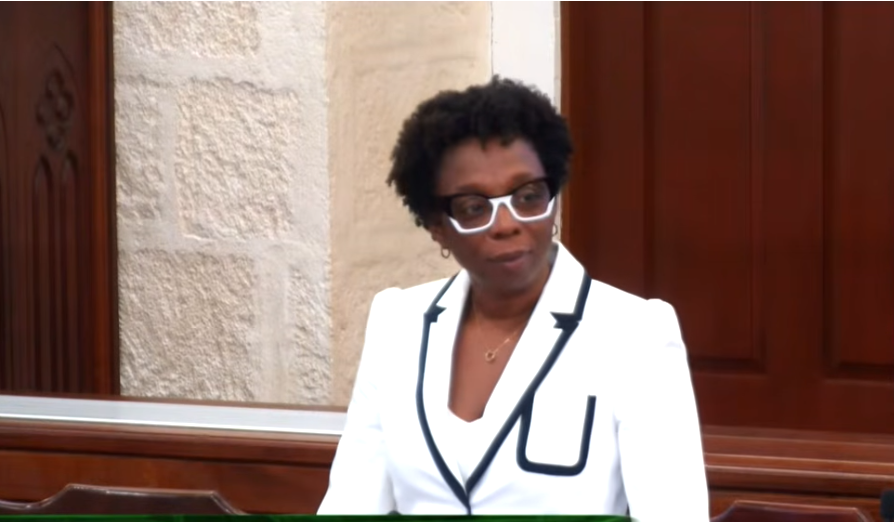
Government backbench MP and union leader Toni Moore has proposed a sweeping overhaul of the social protection system, warning that thousands of workers risk being left without coverage as traditional employment patterns give way to gig work, freelancing and multiple jobholding.
The St George North MP introduced a resolution to establish a National Portable Benefits Framework, describing it as a necessary response to a labour market that has outgrown the country’s existing National Insurance Scheme (NIS).
As “worker season” leads up to May Day, Moore told fellow lawmakers that the National Insurance and Social Security Service, established in 1967, w as built for a reality that no longer exists for a large portion of the population. She described the resolution not merely as a policy proposal, but as a “necessary evolution” and a “call for action” in a rapidly changing labour landscape.
The core of the resolution is a fundamental shift in how social security is collected and managed: social security must follow the worker, not the job. Moore emphasised that the current system is under strain because it was designed for a world of stable, full-time, single-employer jobs — a model that is increasingly at odds with modern work.
She said: “A Barbadian worker might find himself or herself working in a rideshare in the morning, going up to the airport and hustling as a red cap in the afternoon, and in the evening time, working security… In other words, workers find themselves in multiple jobs or with multiple employers over the course of a day. Similarly, we have it with domestic workers where they are employed by different households… and yet they work without protection.”
Moore argued that the gap between how people work and how they are protected is “widening every year”, creating a “present crisis” for those in non-standard forms of work, such as short-term contracts, freelancing and digital platform work.
She highlighted the plight of those who fall through the cracks, specifically naming ride-share drivers, musicians, artists and media workers. She stressed that these individuals are often subject to “disguised employment”, where they are treated as independent contractors to evade social protection.
“They are not marginal. They are the very backbone of the Barbadian economy. Yet because of the outdated design of our social security system, these workers remain largely unprotected without the same access to benefits and security that should be the right of every working person.”
Citing the 17th Actuarial Review (2022), Moore revealed that approximately 30 per cent of the employed population works in the informal sector, and less than 20 per cent of self-employed workers were enrolled in the NIS at the time of the report. She warned that inaction would lead to the eventual collapse of the fund.
She suggested: “Bringing non-standard workers into mandatory coverage expands that contribution base, leading to greater fund sustainability and better, more secure pensions for all of us. Widening the contribution base must be seen as the most sustainable path to NIS solvency.”
Anticipating criticism regarding the financial burden on small businesses and workers, Moore was firm. She argued that the “real burden” is the current “free-for-all”, where compliant employers carry the weight for those who evade the system.
“Some will say this is an added burden on workers at a time when every single dollar counts. But I would like to suggest to workers who will have that view that they are already paying the highest price. They pay it when they get sick and have to be at home with no income… they pay it when they reach old age and realise they have nothing to fall back on except the discretion of the system. Portable benefits do not add a burden; they end the burden of workers carrying every crisis on their own.”
Moore called for the development of a modern digital infrastructure capable of tracking micro-transactions in real time, moving away from a system that traditionally functions on a monthly basis. She proposed a tripartite technical implementation committee, chaired by an independent senior actuary, to oversee the design and rollout of the framework.
Her goal is to have the system ready as a “Fifth Republic anniversary gift” to the nation by November 30, 2026.
“In 1967, we built the NIS as an act of nation-building. In 2021, when we became a republic, we declared that sovereignty belongs to the people. Now in 2026, this resolution is asking this Parliament of Barbados to make a third declaration: that every worker belongs to the social contract. If fairness is radical, then let us get radical.”The resolution seeks to ensure that no Barbadian reaching retirement discovers that “decades of work counted for nothing”, signalling to the workforce that they are seen, valued and protected.
(RR)
The post Moore proposes ‘portable’ social security for all workers appeared first on Barbados Today.