
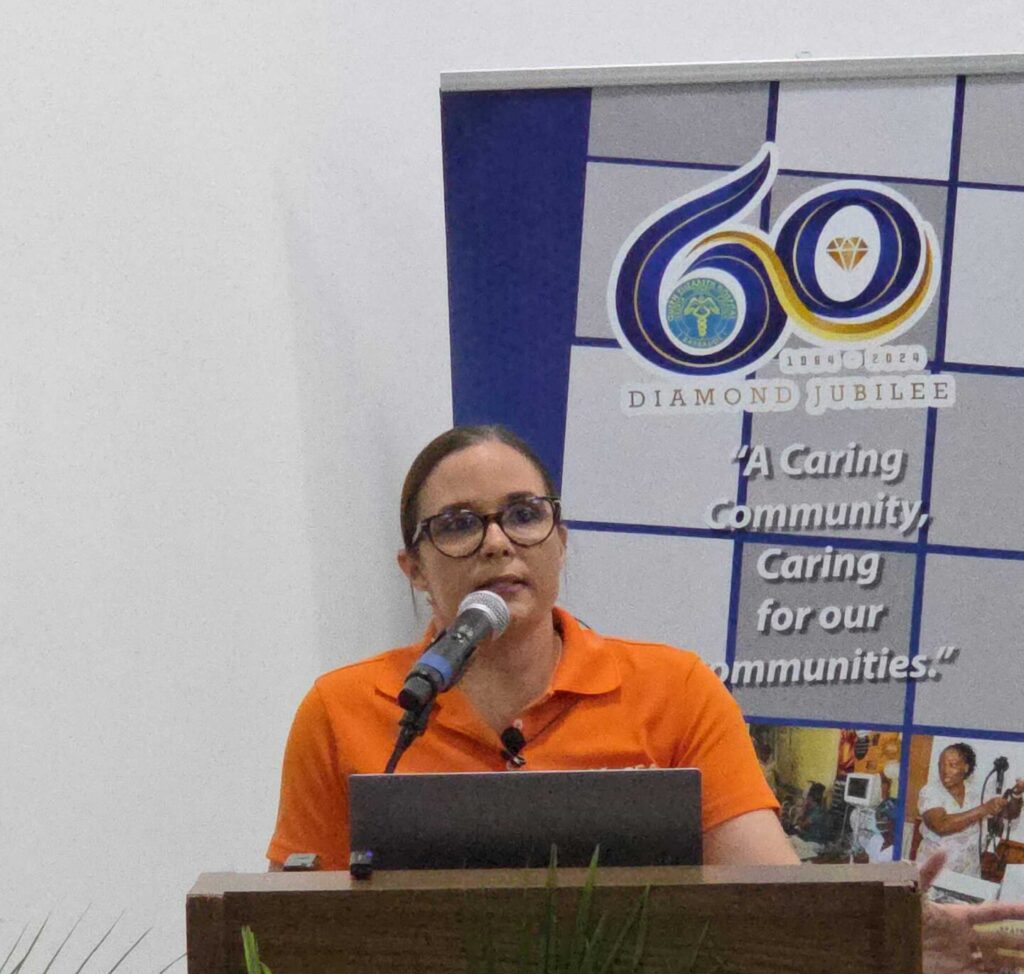
Synthetic drugs that can evade standard hospital tests are posing growing challenges for healthcare workers, the National Council on Substance Abuse (NCSA) warned on Tuesday.
The profile of illicit drug use on the island has changed with synthetic drugs and chemically modified cannabinoids requiring greater vigilance from medical professionals, said NCSA research and information officer Laura Lee Foster.
She told a workshop for doctors, nurses and allied health professionals of a rapid shift from traditional illicit substances to synthetic alternatives that are harder to detect, manage and regulate.
Citing a 2024 regional rapid assessment study conducted with the Organisation of American States (OAS), Foster said synthetic drugs were now firmly established here.
The research highlighted a sharp rise in ecstasy seizures across the island — from a single tablet recorded in 2012 to several thousand in recent years — alongside the emergence of methamphetamine, synthetic cannabinoids and semi-synthetic compounds such as hexahydrocannabinol (HHC).
Foster told the healthcare workers: “Our research is not meant to be an academic exercise; it’s not for a research report to sit on a shelf and gather dust. We want it to be used to do something useful at the policy level and at the programming level.”
According to NCSA data, ecstasy remains the main synthetic substance circulating in Barbados, followed by methamphetamine. Field reports, media monitoring and testing conducted by the Forensic Sciences Centre have also confirmed the presence of synthetic cannabinoids sold as “K2” or “Spice”, liquid “lean”, ketamine and various prescription sedatives.
Law enforcement and research data indicate that a main supply route for these newer substances originates in North America, with Canada specifically cited as a key source market.
Interceptions at ports of entry, international baggage seizures and targeted social media monitoring have provided evidence of these trafficking routes.
Foster highlighted a significant change in the physical appearance of these substances, noting that the vast majority arrive as brightly coloured tablets or in specialised packaging designed to mimic commercial products or appeal to younger people. She cautioned that these formulations create serious challenges for analysis and medical diagnosis.
She said: “The danger is that these things are always changing and you just can’t keep up with what they contain and the effects that they may have, because at the end of the day, once you modify, the potential for changing the effects is also there.
“When we put the danger of these things together with the unknown, now what we have is a very real risk for things like adverse effects, overdose, and other mental and physical health consequences, including fatal outcomes.”
The rapid changes in drug use present immediate challenges for emergency department staff and first responders. Unlike traditional substances such as alcohol, cannabis or cocaine — for which clinical signs and toxicology screening procedures are long established — synthetic compounds frequently evade standard hospital drug tests.
Users themselves are often unaware of the exact chemical composition of the substances they have ingested.
This gap in testing forces clinicians to rely heavily on physical observation, patients’ accounts and treatment of symptoms when patients arrive needing urgent care. Foster urged medical practitioners to familiarise themselves with international guidelines, such as Project Neptune, which offers clinical guidance for managing harm associated with club drugs and novel psychoactive substances.
“Clinicians often find themselves having to rely on patient reports,” Foster said. “Without knowing for sure what the patient has consumed, you’re going to have to rely on that clinical presentation. Make it your business to find out what clinical guidelines exist for some of these newer drugs, especially those that we’re seeing pop up here, and make sure that you know where to access them so that you can get them in a hurry.”
The NCSA officer also raised concerns about exposure risks for emergency department staff and first responders handling unknown substances, advising greater caution when receiving patients.
Foster suggested clinical vigilance must be paired with awareness of working procedures to ensure patients receive prompt treatment.
“Make it your business to find out what clinical guidelines exist for some of these newer drugs… do your research, find out what is out there to guide you,” Foster said. “The drug landscape is one that’s very dynamic… new substances appear frequently, patterns of use change, and information regarding effects and management of cases can change as well.”
She continued: “If you encounter a situation where you think involves drugs or a substance that’s newer to Barbados… report it to agencies like us at the NCSA because it’s going to be very important for us in terms of our national monitoring and surveillance so we can then plug that into the national response as well.”
(RR)
The post NCSA: Synthetic drugs a growing challenge for healthcare workers appeared first on Barbados Today.