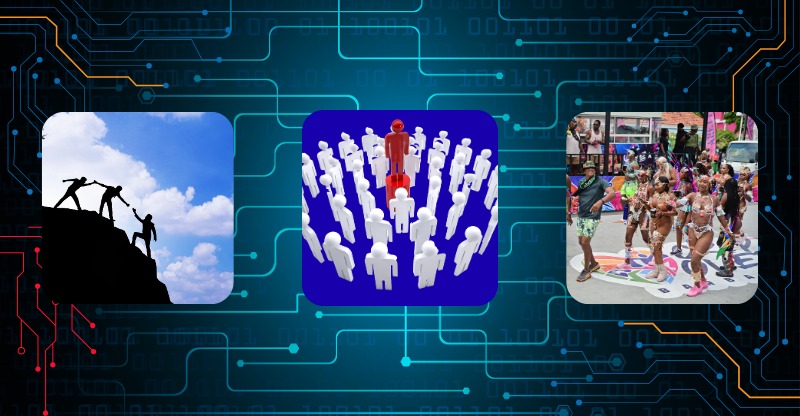
If you work in technology across Barbados and the wider Caribbean, you can almost feel it. The region stands at a crossroads. One path continues with business as usual, relying on familiar processes, traditional structures, and incremental change. The other embraces the reality that the world is rapidly becoming digital-first and that our future competitiveness depends on our ability to adapt.
Around the globe, digital transformation is reshaping economies and societies.
Governments are delivering more services online, businesses are automating operations, artificial intelligence is changing how work gets done, and citizens increasingly expect instant access to information and services from the devices in their pockets. In some countries, digital platforms have become so integrated into daily life that people can communicate, bank, shop, access government services, and make payments without ever touching cash or a piece of paper.
Across the Caribbean, the signs of this transformation are becoming increasingly visible.
The Queen Elizabeth Hospital has embarked on a major digital transformation initiative aimed at modernising patient records and improving the delivery of healthcare services. Barbados Port Inc. has evolved from a largely paper-based operation into a highly connected digital hub that facilitates trade and logistics.
Barbados and Guyana have recently announced plans to allow citizens to travel between both countries using national identification cards, a reality made possible not only through digital transformation but also through digital integration.
Together, these developments illustrate how technology is increasingly reshaping the way governments, businesses, and citizens interact across the region.
For many, these initiatives represent progress. They promise improved efficiency, better services, and new opportunities for economic growth while positioning the Caribbean to compete in an increasingly digital economy.
Yet while digital transformation is often framed as a technology challenge, technology may be the easiest part. The Caribbean’s greatest obstacle is unlikely to be software, cloud platforms, or artificial intelligence. It may be whether our institutions, leaders, and societies are prepared to embrace the governance, leadership, and cultural changes necessary to unlock the full value of a digital future.
The first challenge is building trust in a digitally sceptical society.
As governments and businesses digitise more services, they inevitably collect, process, and share greater volumes of information. Healthcare systems, ports, banks, utility companies, government agencies, and even regional travel initiatives are becoming increasingly dependent on digital infrastructure and data.
The benefits are obvious, but so too are the risks.
One practical step towards building the trust needed for this digital future would be to adequately resource the Office of the Data Protection Commissioner. As of the writing of this article, the Office remains a small operation despite the growing responsibility placed upon it. A stronger and better-resourced commissioner could work alongside both government and private sector organisations to help ensure that digital transformation advances at the same pace as privacy, governance, and accountability.
Recently, Barbados Port Inc. disclosed that it has experienced several cyberattack attempts as its operations have become increasingly digital. The revelation should not surprise anyone. Successful digital transformation makes organisations more efficient, more connected, and unfortunately more attractive to cybercriminals as well.
The question is no longer whether organisations will face cyber threats.
The question is whether they have the governance, policies, transparency, and accountability mechanisms necessary to manage them. As artificial intelligence, cloud computing, and digital services become embedded into daily operations, public trust will increasingly depend on the ability of institutions to demonstrate that they can manage data responsibly and securely.
The second challenge is leadership and skills.
Technology can be purchased and infrastructure deployed. What cannot be bought as easily is the knowledge required to use those investments effectively.
Digital transformation requires leaders who understand more than budgets and procurement. They must understand the strategic implications of data, cybersecurity, privacy, artificial intelligence, and risk.
Equally important, organisations must invest in developing the skills of their workforce to ensure that employees can participate in and benefit from an increasingly digital economy.
Within the technology industry, we often refer to it as “preaching to the choir.”
Whenever national associations, regulators, or government agencies host workshops on cybersecurity, digital transformation, or technology leadership, it is often the IT administrators, security officers, and technical personnel who are sent to attend.
These are usually the very individuals who already understand the risks, opportunities, and urgency of the issues being discussed.
Yet when these same professionals are asked whether leadership would approve the budgets and strategic investments required to support digital transformation, the answer is often less certain. What emerges is an internal struggle, not over technology, but over understanding, priorities, and business value.
Without informed leadership and a digitally capable workforce, even the most ambitious transformation initiatives risk becoming expensive technology projects that fail to deliver their intended value.
Perhaps the most overlooked challenge, however, is culture.
Digital transformation is ultimately about connection. It is about systems talking to systems, organisations collaborating with organisations, and data moving securely between trusted parties to create new services, opportunities, and value.
Consider the role of APIs, the digital bridges that allow systems to exchange information and services. Every modern digital economy depends on them.
When you book a hotel room or airline ticket through Expedia, the platform communicates with airlines, hotels, payment providers, and reservation systems in seconds. Behind the scenes, APIs make this possible.
The same technology allows banks to integrate services, governments to streamline citizen interactions, businesses to create new products, and organisations to unlock value from information that would otherwise remain trapped in isolated systems.
Yet APIs require something technology alone cannot provide: a culture that values collaboration as much as it values control.
In the Caribbean, our culture of mistrust sometimes extends beyond politics and public discourse into our strategic and business environments. Information is often viewed as something to be protected rather than leveraged. Data is treated as a possession rather than an asset capable of creating value when shared appropriately and securely.
The result is that organisations often operate as digital islands. Valuable information remains trapped within individual systems, citizens are asked to provide the same information repeatedly, services become fragmented, and opportunities for innovation are lost.
The recent Barbados-Guyana travel arrangement offers a glimpse of what becomes possible when institutions move beyond siloed thinking and embrace integration. The true value of digital transformation is not created when individual systems simply become digital.
It is created when those systems begin working together, creating new ways of doing business, unlocking economic opportunities, reducing friction, and delivering better experiences for citizens and customers alike.
The Caribbean’s digital future will not be determined by software, cloud platforms, or artificial intelligence alone. Those technologies already exist. Our success will ultimately depend on whether we can build trusted institutions, develop informed leaders, and foster a culture of collaboration capable of unlocking the full value of the opportunities before us.
For decades, the region has spoken about competitiveness, productivity, regional integration, and economic diversification.
Digital transformation can help achieve those goals, but only if we embrace the changes that come with it.
The technology is ready. The question is whether we are.
Steven Williams is the executive director of Sunisle Technology Solutions and the principal consultant at Data Privacy and Management Advisory Services. He is a former IT advisor to the Government’s Law Review Commission, focusing on the draft Cybercrime Bill. He holds an MBA from the University of Durham and is certified as a chief information security officer by the EC Council and as a data protection officer by the Professional Evaluation and Certification Board (PECB). Steven can be reached at Mobile: 246-233-0090; Email: steven@dataprivacy.bb
The post OPINION: The real Caribbean digital divide isn’t infrastructure — It’s trust, leadership, and culture appeared first on Barbados Today.